


The Autumn Jewel: October Daphne (Sedum sieboldii)
- Athena

- Jul 4
- 4 min read

Sculpting a dramatic, weeping wheel of glaucous blue-grey medallions that erupts into a vivid pink firestorm just as the rest of the garden fades
Alternative Names: October Daphne, Hylotelephium sieboldii, Siebold's Stonecrop, Japanese Stonecrop, Medallion Sedum
Introduction
Botanical Name: Sedum sieboldii (syn. Hylotelephium sieboldii)
Native Habitat: Native originally to the rocky, sun-baked volcanic cliffs and high-drainage mountain slopes of the island of Shodoshima in Japan. Its wild evolutionary origins wireframe this succulent to cascade down steep rock faces, anchoring its roots into minimal mineral pockets and enduring open, unshaded mountain sun with absolute ease.
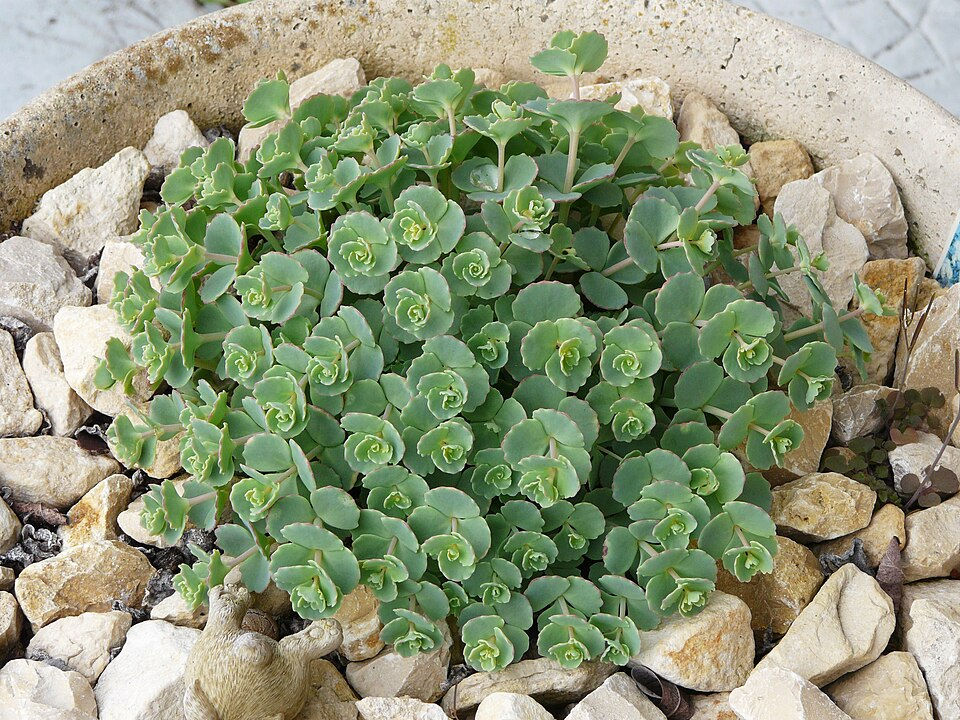
Characteristics: This is an exceptionally elegant, clump-forming and trailing succulent perennial belonging to the Stonecrop family (Crassulaceae). It forms a highly symmetrical, circular mound of unbranched, arching stems that trail gracefully outward from a central root crown like the spokes of a wheel. The fleshy, round, wedge-shaped leaves are arranged in distinctive whorls of three. They display a beautiful glaucous blue-grey to silvery-mint color, cleanly outlined with a delicate pinkish-red margin. In mid to late autumn, the tip of every single trailing stem is capped by a dense, flat cluster of bright, star-shaped rose-pink flowers.
Pros
Elite Weeping Geometry: The arching, spoke-like trailing habit delivers an unmatched structural outline that makes it a premier choice for rock walls and hanging stone troughs.
Outstanding Late-Season Color: Provides a critical burst of high-saturation pink warmth in October and November when most dry-garden perennials have gone dormant.
Superb Winter Freezing Resilience: Unlike tender South African succulents, its root crown shrugs off severe sub-zero continental freezes effortlessly.
Fascinating Seasonal Shifts: The blue leaves take on spectacular shades of copper, orange, and intense red as the cold autumn nights approach.
Cons
Highly Vulnerable to Standing Water: Sticky clay or poorly draining soils during the winter rest phase will rapidly rot the central root crown.
Slight Stiff-Stem Brittleness: The structural arching stems are heavy with water and can cleanly snap at the base if stepped on or hit by strong garden tools.
Highly Attractive to Slugs: The juicy, fleshy medallion leaves can become a prime target for snails and slugs during early spring growth.

The Field Performance Profile
Light Requirement
Absolute full sun to very bright, partial afternoon shade. It requires a minimum of six hours of direct daily solar radiation to lock in its bright blue-grey foliage color, maintain its tight leaf spacing, and trigger a heavy autumn bloom. In deep shade, the stems become weak, green, and loose.
Cold Hardiness
Down to minus 25 to minus 29 degrees Celsius (minus 13 to minus 20 degrees Fahrenheit). It is an incredibly reliable, cold-hardy perennial succulent thriving comfortably down to USDA Zone 5 with zero winter protection needed.
Heat Tolerance
Up to 38 to 40 degrees Celsius (100 to 104 degrees Fahrenheit). It exhibits excellent heat resistance, shrugging off hot summer dry spells, intense retaining wall radiation, and low ambient humidity.
Soil Requirement
Demands sharp, rapid drainage. It absolute thrives in a poor, sandy, gravelly, or stony matrix with a neutral to highly alkaline pH (7.0 to 8.0). It is perfectly adapted to limestone terrains. Rich, organic-heavy, or compost-loaded soils must be strictly avoided.
Root Structure
A thick, tough, semi-tuberous central root crown supported by a fine network of lateral fibrous roots that excel at securing the plant into steep rock crevices.
Height & Spread
Maintains a low vegetative canopy of only 10 to 15 cm (4 to 6 inches) high, while its trailing stems cascade outward to form a mature lateral wheel of 30 to 45 cm (12 to 18 inches) in width.
Watering
Low water needs. Follow the "soak and dry" protocol strictly during the spring and summer active growth phases. Water deeply only when the soil matrix is completely dry. Once established, it is highly drought-resilient. In winter, as the stems die back, cut watering back to a bare minimum.
Lifespan
Long-lived perennial succulent. The central root crown strengthens and pushes out an increasingly dense wheel of fresh arching stems every single spring.
Flower Color
Vibrant, high-saturation rose-pink or bright magenta, accented by deeper pink stamens.
Blooming Period
Mid-autumn to late autumn (typically peaking beautifully from October through November, just before the true winter frosts).
Foliage Status
Herbaceous Perennial Succulent. The blue-grey leaves remain thick and stunning all summer, turn fiery copper-red in late autumn, and the stems naturally die back to the ground after a hard winter freeze.
Difficulty Level
Beginner. Once tucked into a well-drained rock pocket or container and left alone, it requires zero routine care to look flawless.
High-Yield Propagation
1. Late-Spring Stem Cuttings (The Most Efficient Method)
When: Late spring or early summer when the arching stems are roughly 10 cm long and growing vigorously.
How: Snip a healthy stem right near the central crown. Strip the bottom two whorls of leaves. Let the cutting sit in a dry, shaded room for 2 days to allow the soft cut to form a clean callus. Once calloused, push the bare node into a pot filled with damp limestone grit and sand. Placed in a bright, sheltered spot, roots will anchor eagerly within 2 weeks, forming a sturdy new crown by autumn.
Pro Care Tips & Secrets
Landscape Vision
Sedum sieboldii represents the absolute peak of structural elegance, seasonal color efficiency, and cold-hardy utility in a modern water-wise garden layout. It completely redefines how we manage dry stone ledges, elevated gravel paths, and limestone containers, delivering a magnificent combination of glaucous blue medallions and late-autumn pink fire that soft annuals can never match. When positioned in full sun, provided with poor, rapid-draining stony ground, and protected from standing winter wet, this resilient Japanese native rewards the grower with a trouble-free living sculpture that grows more beautiful with each passing season.
Tags: Perennial | Drought-Tolerant | Full-Sun | Ground-Cover | Rock-Garden | Trailing-Plant


Comments