


The Coastal Shield: Giant Pigface (Carpobrotus acinaciformis)

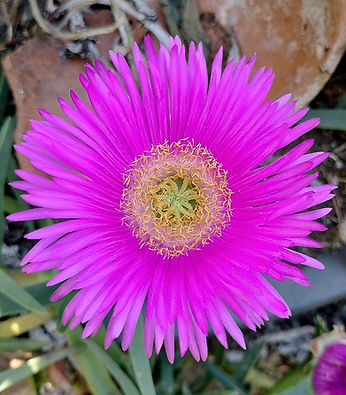
Indestructible, bone-dry succulent carpets built for baking sun and sterile limestone screes.
Alternative Names: Giant Pigface, Elands Sourfig, Sally-my-handsome, Sea Fig
Introduction
Botanical Name: Carpobrotus acinaciformis (Family Aizoaceae)
Native Habitat: Native to the coastal sands, rocky cliffs, and arid slopes of South Africa's Western Cape. It evolved to thrive in environments exposed to relentless salt spray, shifting sands, intense UV radiation, and severe summer droughts, making it naturally adapted to poor, alkaline, and mineral-heavy coastal soils.
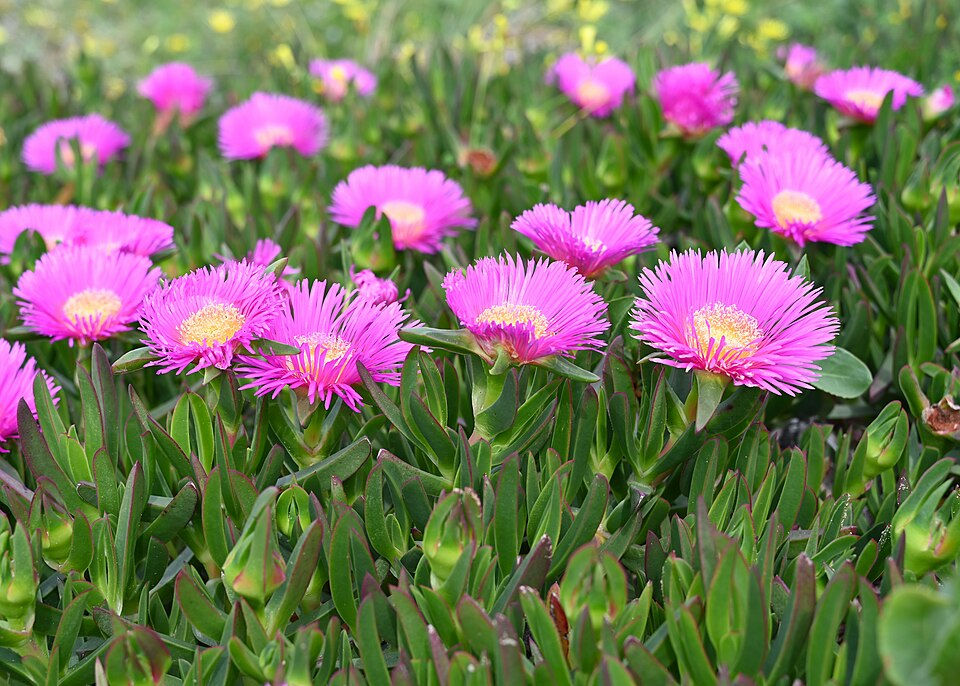
Characteristics: This is a trailing, highly vigorous, mat-forming succulent perennial that acts as an aggressive ground cover. It features thick, fleshy, three-sided (triquetrous) leaves that are distinctively curved like a scimitar sword, often taking on a reddish-purple tint along the edges when stressed by sun or drought. Throughout late spring and summer, the green mats are punctuated by massive, daisy-like magenta-purple flowers with hundreds of linear petals surrounding a dense center of yellow stamens. The blossoms open only in bright sunshine and close during cloudy weather, followed by large, edible, fig-like fruits.
Pros
Elite Drought Defiance: Stores immense water reserves inside its thick leaf matrix, surviving months of blistering heat with zero rainfall or supplemental irrigation.
Outstanding Slope Stabilization: The sprawling stems root instantly wherever they touch bare ground, pinning down loose gravel, sandy banks, and eroding limestone slopes.
Total Salt and Wind Immunity: Completely unfazed by high-velocity wind drying and salty coastal atmospheres.
Exceptional Pest Resistance: The tough, latex-filled succulent skin is highly resistant to common garden insects, snails, and underground burrowing pests.
Cons
Aggressive Space Monopolizer: Its rapid, trailing growth habit can easily smother smaller, delicate rockery neighbors if not kept in check.
Zero Frost-Pocket Tolerance: The water-logged leaves are highly susceptible to cellular collapse during hard, prolonged freezing winter conditions.
Heavy Foot-Traffic Vulnerability: While tough against weather, the brittle, fluid-filled leaves will easily snap and crush under direct, repeated foot traffic.
The Field Performance Profile
Light Requirement
Absolute full sun. It requires a minimum of six to eight hours of direct, unrestricted solar baking to keep the growth habit tight and to trigger the massive summer flowering mechanism. Deep shade causes the stems to stretch weakly and fail to bloom.
Cold Hardiness
Down to minus 4 to minus 6 degrees Celsius (24 to 21 degrees Fahrenheit). It can tolerate brief, light overnight winter frosts but will suffer extensive tissue damage or death during severe, prolonged continental freezes.
Heat Tolerance
Exceptional. Shrugs off intense, ambient air temperatures climbing up to 42 to 45 degrees Celsius (107 to 113 degrees Fahrenheit) without showing any signs of wilting or scorched tips.
Soil Requirement
Demands ultra-porous, rapid internal drainage. It thrives in lean sand, gravelly limestone mixes, scree fields, and poor mineral matrices with a neutral to highly alkaline pH (6.5 to 8.5). It will quickly rot in heavy, water-retentive clay.
Root Structure
A widespread, shallow network of fibrous roots that emerge from every single stem node touching the soil surface, creating an efficient surface moisture collection matrix.
Height & Spread
Maintains a low, ground-hugging profile of 15 to 25 cm (6 to 10 inches) in height, while trailing stems can spread horizontally anywhere from 1.5 to 3 meters (5 to 10 feet) outward from the central crown.
Watering
Extremely low water needs. Once established, it survives entirely on natural rainfall. If cultivating in dry inland environments during peak summer, a single deep monthly soaking is more than enough. The soil must dry out completely between sessions.
Lifespan
Long-lived perennial succulent. The trailing mats continually self-renew by rooting from nodes, keeping the colony active for decades if left undisturbed in dry ground.
Flower Color
Brilliant, neon-saturated magenta, deep purplish-pink, or vibrant violet-rose with bright yellow centers.
Blooming Period
Late spring into mid-summer (typically peaking from May through July, with occasional scattered blooms arriving in warm autumn windows).
Foliage Status
Strictly evergreen. The plump, geometric green-to-glaucous leaves remain structurally active and colorful throughout the entire year.
Difficulty Level
Beginner. It is virtually unkillable provided it is planted in free-draining ground and never overwatered.

Propagation Methods
Nodal Stem Cuttings (The Absolute Simplest Route): Because this plant roots with extreme ease, you can multiply it rapidly at any time during the active spring or summer growing season. Use a sharp knife to snip off a healthy, firm trailing stem segment roughly 15 to 20 cm long. Strip off the lower leaves to expose at least two to three growth nodes. The Critical Step: Allow the cutting to sit in a dry, shaded spot for 3 to 4 days until the wet cut ends form a thick, dry white callus. Push the callused stem directly into a sandy limestone grit bed. It will establish a functional root system within 10 to 14 days without any artificial misting.
Layering (The Lazy Natural Method): Look along the perimeter of an established mat for trailing stems that are running over bare stone. Press a chosen stem node firmly down into a pocket of loose gravelly sand and pin it down with a heavy stone. Within two weeks, the node will push strong white anchor roots directly into the substrate. Once rooted, snip the trailing stem away from the main mother plant with pruners, and lift your new, fully established individual plant for relocation.
Pro Care Tips & Secrets
To prevent your succulent mats from turning into a leggy, thin tangle of woody stems with very few flowers, you must avoid the temptation to feed them. Never apply high-nitrogen organic fertilizers, compost blankets, or nutrient-rich manures to this species. Excessive nitrogen spikes vegetative growth artificially, causing the cells to fill with excess water, which weakens their natural pest defenses and shuts down summer bud formation completely. Keep the soil lean, sterile, and strictly mineral-dominant to guarantee thick leaves and maximum flower density.
When managing large, expanding mats along steep stone walls or border perimeters, perform an annual trimming right after the summer flowering cycle wraps up. Use sharp pruners to cut back trailing runners that are escaping their designated boundaries. When making cuts, always slice cleanly right above a leaf node; this forces the plant to push out multiple compact lateral branches from that point, transforming a single thin vine into a dense, thick carpet that chokes out weeds completely.
If a cold winter snap causes the outer leaves to turn mushy, black, or translucent from frost damage, do not rush out to prune them immediately. Leave the damaged, deflated tissue intact on the plant throughout the remaining winter weeks. This dead layer serves as a natural, insulated thermal blanket that shields the vulnerable inner central crown from deeper, fatal frost penetration. Wait until the warm days of mid-spring arrive and all danger of frost has passed before cleanly shearing away the unsightly dry winter damage to expose the fresh green growth below.
Tags: Succulent | Drought-Tolerant | Full-Sun | Ground-Cover | Slope-Stabilizer | Summer-Bloom


Comments