


The Cottage Skyscraper: Hollyhock (Alcea rosea)


Towering, architectural spires built for blazing sun, radiant stone walls, and high-yielding edible flushes.
Alternative Names: Hollyhock, Althea, Garden Hollyhock, Gülhatmi
Introduction
Botanical Name: Alcea rosea (Family Malvaceae)
Native Habitat: Originally native to the rocky hillsides, open sun-baked valleys, and dry meadows of southwestern China and Central Asia, before naturalizing extensively across the Mediterranean basin and Anatolia centuries ago. It is biologically wired to thrive in lean, unamended mineral backgrounds and withstand intense summer baking by utilizing a powerful root system to draw moisture from deep underground limestone fissures.
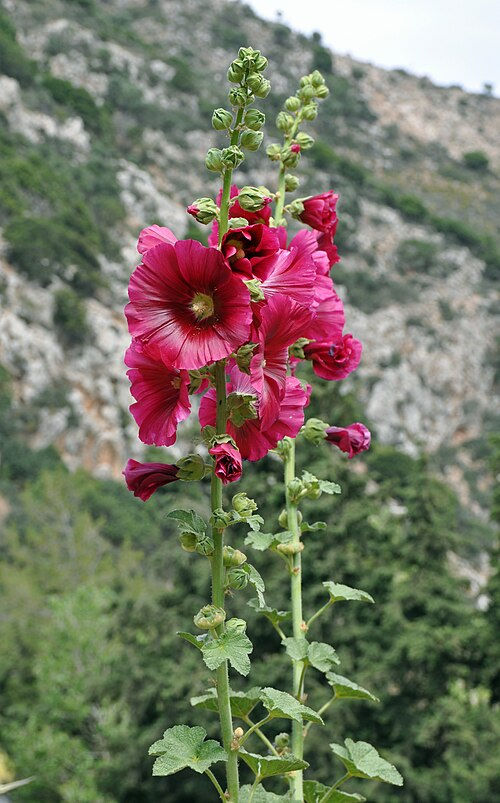
Characteristics: This is a monumental, stately herbaceous perennial (frequently growing as a robust biennial) that delivers a commanding vertical presence. From a massive, woody taproot, it pushes out a heavy basal rosette of large, rough, palmately veined, heart-shaped green leaves covered in coarse hairs. In late spring, a collection of thick, unbranched, skyscraper-like flowering spikes rise rapidly toward the sky. These towering columns are sequentially smothered from bottom to top in massive, crepe-paper-textured, saucer-shaped blossoms. Like its mallow cousins, the entire plant is rich in beneficial, soothing mucilage.
Pros
Elite Vertical Architecture: Provides unmatched structural height, making it the premier choice for anchoring rear borders, disguising blank walls, and softening fence lines.
High-Value Multi-Yield Asset: Every part of the plant is edible and functional—ranging from the tender mucilaginous spring greens to the oversized colorful blossoms used for striking culinary presentations.
Superb Alkaline Limestone Affinity: Thrives comfortably in lean, high-pH chalky profiles and stony substrates where deep nutrition is limited.
Relentless Summer Pollinator Magnet: The open saucer blossoms present an easily accessible, massive supply of nectar and heavy pollen for bumblebees and beneficial insects.
Cons
Aggressive Rust Susceptibility: Highly prone to hollyhock rust (Puccinia malvacearum), a fungal disease that creates orange-brown pustules on the lower foliage, causing leaves to yellow and drop prematurely.
High Wind Vulnerability: The immense height of the flowering spikes makes them susceptible to snapping or lodging during heavy summer thunderstorms if left fully exposed without structural backing.
Immovable Root Frame: The deep, woody, sensitive taproot system makes relocating established mature specimens nearly impossible without triggering fatal transplant shock.
The Field Performance Profile
Light Requirement
Absolute full sun. It demands a minimum of six to eight hours of direct daily solar radiation to build thick, self-supporting flower columns. Any amount of sustained shade causes the giant spikes to lean aggressively toward the light, producing weak, sparse bud clusters.
Cold Hardiness
Extremely hardy. Down to minus 30 to minus 35 degrees Celsius (minus 22 to minus 31 degrees Fahrenheit). The substantial root crown enters a stable winter dormancy, completely unfazed by deep frost penetration, frozen topsoil matrices, or heavy snow covers.
Heat Tolerance
Exceptional. Performs flawlessly through intense, ambient air temperatures climbing up to 40 to 42 degrees Celsius (104 to 108 degrees Fahrenheit), baking comfortably against hot stone walls provided its taproot has established deep access to moisture.
Soil Requirement
Extremely adaptable but requires sharp internal drainage. It thrives in poor, sandy, gravelly, or chalky mineral loams with a neutral to highly alkaline pH (6.5 to 8.5). It will suffer from root decline and winter rot if trapped in heavy, water-saturated clay.
Root Structure
A thick, heavy, deeply penetrating vertical taproot supported by a tough, woody crown complex designed to anchor massive top-heavy growth.
Height & Spread
A dominant landscape presence. Flowering spikes shoot vertically anywhere from 1.5 to 2.5+ meters (5 to 8+ feet) high, while the basal leaf rosette expands horizontally to cover a footprint of 60 to 90 cm (24 to 36 inches) wide.
Watering
Low to moderate water needs. Newly planted seedlings require consistent moisture to establish their root depth. Once fully established, they are highly drought-tolerant; a single deep soaking every two weeks during the peak summer flowering window is more than enough to maintain pristine bud expansion.
Lifespan
Short-lived perennial or true biennial. Individual crowns typically remain highly productive for 2 to 3 seasons before naturally declining, but the colony self-perpetuates indefinitely in the landscape via highly efficient self-seeding.
Flower Color
An immense spectrum encompassing stark white, pale yellow, soft pink, vibrant crimson, deep maroon, lavender, and a stunning, near-black dark purple.
Blooming Period
Early summer to early autumn (typically opening its first lower blossoms in June and continuously unrolling fresh buds upward along the spike into September).
Foliage Status
Herbaceous. The rough green leaves remain active from early spring through autumn, melting completely back to the ground line after a hard winter freeze.
Difficulty Level
Beginner to Intermediate. Simple to grow from seed, but managing foliage rust and providing appropriate wind shelter requires basic strategic planning.
Propagation Methods
Direct Autumn Sowing (The Natural Route): Because hollyhocks produce large, highly viable seeds and a sensitive taproot that hates being moved, direct sowing onto open ground in late summer or autumn is exceptionally successful. Lightly scratch the surface of a lean, weed-free limestone gravel or sandy bed. Scatter the flat, disk-like seeds thinly, and cover them with a 5 mm layer of fine grit or sand to protect them from birds. Press the ground firmly; robust over-wintering rosettes will establish before the winter freezes arrive, guaranteeing a massive flowering spike the very next summer.
Early Spring Indoor Plugs (The Controlled Route): Start seeds indoors 8 weeks before the last spring frost using deep, individual biodegradable peat pots or root-trainer cells. Sow seeds 5 mm deep into a sandy seed-starting mix. Keep at 18 to 21 degrees Celsius under bright lights. The Critical Step: Plant the entire biodegradable pot directly into the garden field without disturbing or exposing the fragile young taproot to the air.
PERSONAL NOTE
Edibility Profile: Hollyhock (Alcea rosea) is a fully edible, non-toxic member of the mallow family, providing high-volume yields and soothing mucilaginous properties for culinary use.
Fresh Salad Integration: The young, tender green leaves harvested from the center of the basal rosette in early spring can be shredded finely and mixed into raw salads. The massive, colorful petals can be plucked fresh and scattered across salads as a stunning, edible garnish.
Cooked Vegetable Dishes: The mid-sized spring foliage acts as a premium leaf vegetable when cooked. It can be blanched briefly to soften the coarse hairs and then sautéed with olive oil, garlic, and wild onions, serving as a direct substitute for spinach or chard.
Pastry Stuffing Filling: Once steamed and chopped, the nutrient-dense leaves provide an excellent, substantial filling for traditional savory pastries, flatbreads, and gözleme, blending beautifully with olive oil, green onions, and crumbled white cheeses.
Herbal Tea Infusion: The dark maroon or purple petals can be collected and thoroughly dried to create a deeply colored, soothing herbal tea. The high mucilage content lends a velvety coat that is traditionally brewed to soothe dry throats and calm the digestive system.
Nutritional Soup Booster: Adding finely chopped hollyhock leaves to simmering rustic vegetable broths or lentil soups functions as a natural thickening agent, enriching the texture of the soup while boosting its vitamin and mineral content.
Pro Care Tips & Secrets
To completely prevent the spread of devastating hollyhock rust disease without resorting to chemical sprays, you must enforce a strict lower leaf stripping routine. As the main flowering spike begins its rapid vertical climb in late spring, use sharp pruners to cleanly cut away every single leaf from the bottom 30 to 40 cm of the stalk, leaving the lower framework completely bare. This open zone dramatically increases air circulation around the crown and allows the sun to instantly dry the soil surface, breaking the life cycle of fungal spores and keeping the upper blooming spikes perfectly clean.
Never plant hollyhocks in rich, heavily amended garden beds packed with high-nitrogen fertilizers or fresh animal manures. Excessive nitrogen spikes soft, watery vegetative growth, resulting in hollow, top-heavy stems that cannot support their own weight and snap flat during summer windstorms. Lean, unamended mineral ground forces the taproot to grow deeper and more woody, resulting in highly compact, ultra-dense, self-supporting flower spikes that hold their heads high without requiring artificial staking.
When a towering flower spike finishes blooming in late summer and the lower seed pods turn crisp, brown, and papery, do not cut the entire stalk down immediately if you want to change its life cycle. Instead, cut the stalk back by half, leaving the lower green leaves intact, and shake the upper dry pods across your gravel pathways to secure next year's crop. Leaving the lower portion intact for a few weeks allows the plant to naturally channel sugars back down into the root crown, turning a short-lived biennial into a much more stable, long-lived perennial specimen.
Tags: Perennial | Drought-Tolerant | Full-Sun | Structural-Asset | Edible-Yield | Summer-Bloom


Comments