


The Crisp Hydrator: Cucumber (Cucumis sativus)


Sofraların Serinliği: (Cucumis sativus)
Vigorous, fast-growing warm-season annual vines engineered for climbing, requiring consistent moisture profiles, high ambient humidity, and producing high-water culinary pepos.
Alternative Names: Cucumber, Garden Cucumber
Introduction
Botanical Name: Cucumis sativus (Family Cucurbitaceae)
Native Habitat: Originally native to the warm, humid, tropical valleys of the Indian subcontinent (anchored along the foothills of the Himalayas), where it adapted to climbing forest margins and utilizing seasonal monsoon moisture. It was domesticated over three millennia ago and spread extensively through the Mediterranean and Western Asia. Its evolutionary background hardwires an absolute intolerance to frost, a profound reliance on high ambient air humidity paired with consistent soil moisture, and a highly specialized tendril-climbing mechanism designed to elevate its foliage toward filtered forest sunlight.
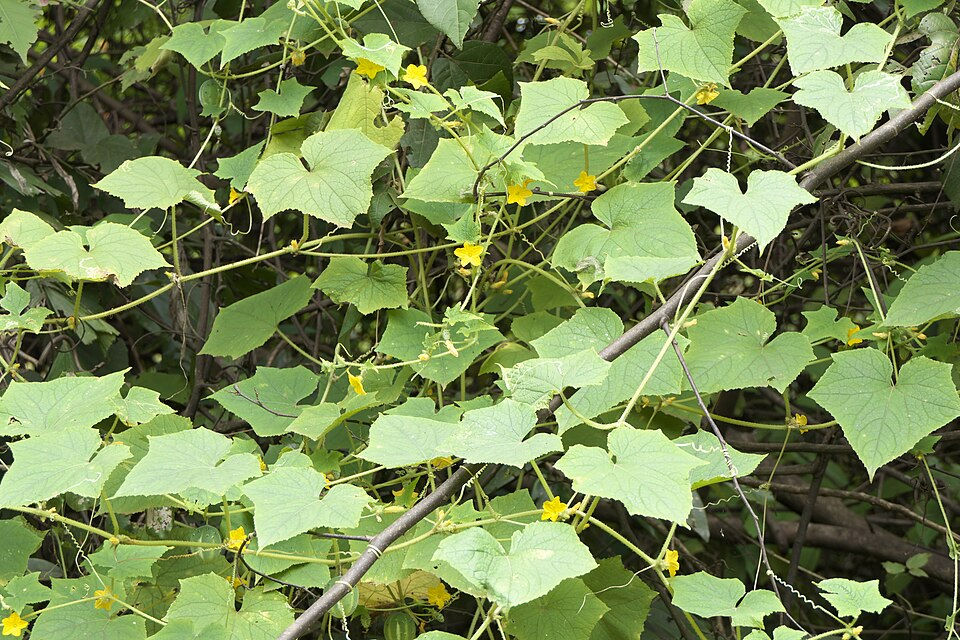
Characteristics: This is a fast-growing, sprawling or climbing herbaceous annual vine capable of extending 1.5 to 3 meters in a single season. The stems are angled, brittle, rough-hairy, and equipped with slender, simple tendrils that wrap tightly around any physical support grid. The leaves are large, alternate, palmately 3 to 5 lobed, with a rough, sandpapery texture and finely serrated margins, providing a dense shade canopy for the developing fruit. The bright yellow, wrinkled flowers emerge from the leaf axils; traditional varieties are monoecious (bearing separate male and female flowers on the same plant), requiring insect vectors for pollination. The fruit is a botanical pepo—a specialized berry with a hard outer rind and a fleshy, seed-bearing interior—typically elongated, cylindrical, and composed of over 95% water.
Pros
Rapid Seed-to-Table Turnaround: Yields crisp, harvestable fruit within 50 to 65 days from germination, offering highly efficient seasonal food production.
Outstanding Vertical Efficiency: Trains effortlessly up trellises, strings, or cattle panels, maximizing food output in intensive backyard plots or greenhouses.
High Hydration Culinary Value: The cool, crisp, low-calorie fruits are staple components of fresh Mediterranean salads, cold yogurt soups (cacık), and pickling pipelines.
Continuous Fruiting Cycle: Regular harvesting triggers the vine to continuously throw out fresh flowers and set new fruit clusters until the end of summer.
Cons
Severe Sensitivity to Downy and Powdery Mildew: The coarse, broad leaves are highly vulnerable to fungal blights (Pseudoperonospora cubensis) if overhead moisture lingers or airflow stalls.
Low Tolerance to Soil Moisture Swings: Sudden transitions from bone-dry to waterlogged soil cause the fruit to accumulate bitter cucurbitacin compounds or develop hollow cavities.
Poor Transplant Recovery Rate: The highly sensitive, brittle root system does not tolerate rough handling or root-ball disturbance during transplanting.

Field Performance & Care Profile
Light Requirement: Full sun. It demands 6 to 8 hours of direct daily solar exposure. While it appreciates slight, high-dappled afternoon shade in scorched, low-humidity interior valleys to prevent leaf wilting, full light is essential for high flower counts.
Cold Hardiness: Extremely frost-tender. The plant possesses zero cold resilience; growth stalls completely below 13°C (55°F). A light frost at 0°C (32°F) will physically collapse the water-rich stems, killing the vine instantly. (WHZ 10a-12b).
Heat Tolerance: High for vegetative growth, but moderate for pollination. Thrives in summer temperatures between 24°C and 35°C (75°F to 95°F). If sustained heat waves spike past 38°C (100°F), the plant may produce exclusively male flowers or drop young fruit.
Soil Requirement: Prefers deep, light, highly fertile, loamy or sandy soils rich in well-rotted organic matter, with excellent internal drainage. It operates best within a pH spectrum of 6.0 to 6.8, where mineral absorption is balanced.
Root Structure: Develops a relatively shallow but highly branched fibrous root system that spreads widely just beneath the soil surface, accompanied by a short, weak central taproot.
Height & Spread: Sprawling ground vines spread 1.5 to 3 meters wide; vertically trellised vines easily climb 2 meters high while maintaining a compact horizontal footprint of 40 cm.
Watering: High and continuous water needs. Requires regular, deep, root-focused irrigation. The soil must be kept uniformly damp (like a wrung-out sponge). Water stress instantly triggers bitter-tasting fruit or misshapen, tapered ends.
Regional Adaptability: Highly successful in sunny coastal plains, river valleys, and irrigated inland gardens with warm summers. It thrives in raised beds with intensive trellis systems and under unheated hoop houses.
Lifespan: Grown strictly as a short-season summer annual.
Flower Color: Five-petaled, bell-shaped bright yellow flowers. Female flowers are easily identified by the miniature, immature cucumber ovary sitting directly behind the petals.
Blooming Period: Continuous from early summer until the first crisp autumn drop, provided the vine remains free of disease and fruit is picked regularly.
Difficulty Level: Moderate. Requires proactive trellis training, strict adherence to root-zone watering, and vigilant monitoring for fungal leaf spots.
Propagation Methods
Direct-Sowing in the Field (The Optimum Route): Because cucumbers hate root disturbance, direct-sowing after all danger of frost has passed and soil temperatures reach 18°C (65°F) yields the sturdiest vines. Prepare a planting hill or row amended with mature compost. Sow seeds 2 cm deep, placing 2 to 3 seeds per spot. Keep the soil evenly damp; seedlings will burst through the surface within 3 to 5 days. Once they develop their first true leaves, thin to the strongest single seedling by clipping the weaker ones at the soil line with scissors—never pull them, as this shreds the roots of the remaining plant.
Early-Spring Biodegradable Paper Pot Seeding: If starting indoors early to beat the season, sow seeds 3 to 4 weeks before the last frost date using individual, deep biodegradable paper or peat pots. Fill with a sterile, loose seed-starting mix, sow 1.5 cm deep, and maintain a steady 24°C (75°F). Provide high-intensity light immediately upon emergence to prevent legginess. When transplanting into the field, plant the entire pot directly into the ground without pulling the root ball out, ensuring the pot rim is completely buried beneath the soil line.

Pro Care Tips & Secrets
To completely eliminate the development of "Bitter-End Syndrome"—where your harvested cucumbers look beautiful but carry a sharp, unpalatable bitterness concentrated near the stem—you must understand the mechanics of cucurbitacin accumulation and implement "Thermal Root Zone Insulation." Bitterness is a natural defensive compound triggered by plant stress, specifically when shallow roots face wild temperature spikes in hot weather. Apply an 8 to 10 cm layer of clean straw, shredded leaves, or clean wood shavings across the entire bed out to the drip line. This thick mechanical blanket keeps the soil surface cool, drops evaporation rates dramatically, and protects the shallow root network from thermal shock, guaranteeing sweet, crisp fruit all summer long.
If you are cultivating cucumbers vertically to maximize space and want to prevent Downy and Powdery Mildew from turning your leaves into brown, crispy paper by mid-summer, you must execute the "Basal Leaf Clearance & Lateral Node Pinching" protocol. Train the main vine up your trellis, but ruthlessly remove all leaves and lateral shoots from the bottom 45 cm of the stem once the vine reaches 1 meter in height. This creates a high-airflow tunnel at the base of the crop, stopping humid air from stagnating near the soil. For the remaining lateral branches above, pinch off their growing tips after they produce two leaves and one fruit cluster. This caps unnecessary vegetative growth, directs all sap energy into sizing up the existing fruit, and maintains a highly organized, open canopy that dries instantly after morning dew.
To achieve flawless, straight cucumbers and avoid the common issue of "Crooking" (where fruits curl into unusable, tight crescent shapes), you must transition from ground cultivation to "Suspended Trellis Mesh Operations." When cucumbers develop on the ground, physical contact with uneven soil clods, mulch pieces, or thick weeds physically obstructs the expanding tip, forcing it to bend. By training the vine up a vertical trellis or a coarse wire panel, the young fruits are allowed to hang completely free in mid-air. Gravity naturally pulls the weight downward as the cells expand, producing perfectly straight, uniform, and cleanly colored cucumbers that are entirely free of yellow dirt blemishes.
Tags: Fruity-Vegetable | High-Yield | Full-Sun | Vertical-Asset | Summer-Harvest | Warm-Season


Comments