


The Glistering Succulent: Purslane (Portulaca oleracea)


Prostrate, red-stemmed succulent survivalists engineered for blistering stone paths, high-evaporation heat waves, and a daily midday carpet of bright satin-yellow stars.
Alternative Names: Purslane, Common Purslane, Little Hogweed, Verdolaga
Introduction
Botanical Name: Portulaca oleracea (Family Portulacaceae)
Native Habitat: Believed to have originated in a wide latitudinal band stretching from North Africa through the Middle East and the Indian subcontinent. It evolved as an opportunistic, sun-loving pioneer on bare gravelly plains, sandy riverbanks, and highly disturbed dry soils. This extreme environment hardwires its unique dual-metabolic pathway (CAM-C4 photosynthesis shift), allowing it to conserve water with unmatched efficiency during severe droughts, while its fleshy, sprawling stems store vast fluid reserves.
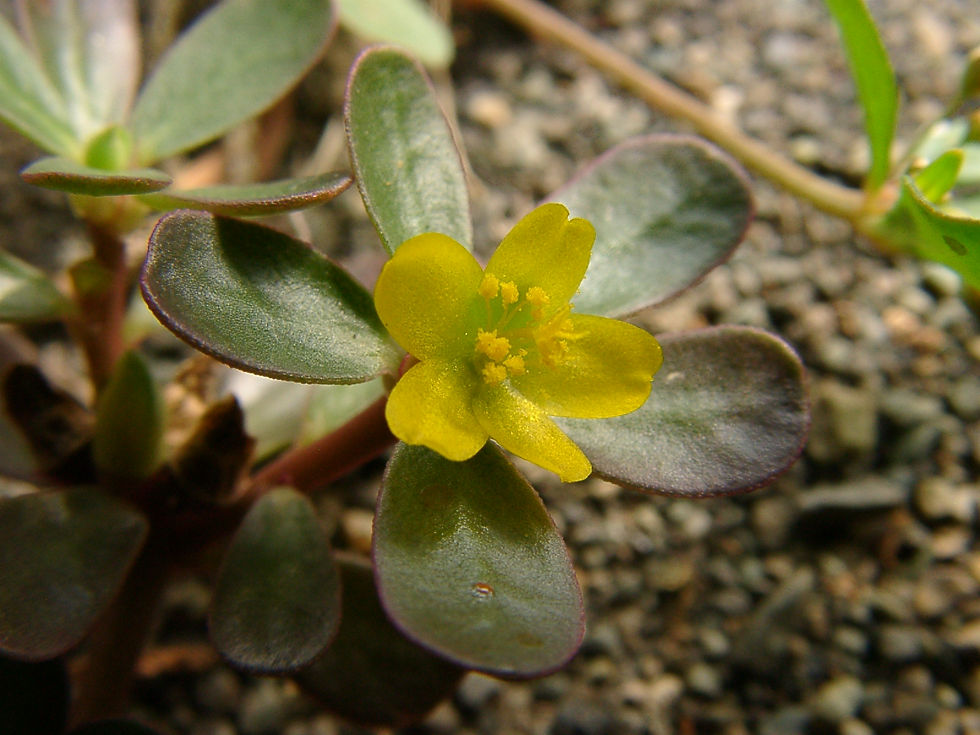
Characteristics: This is a fast-growing, completely prostrate, succulent annual that forms a low-slung, flat, radiating carpet. It features smooth, fleshy, cylindrical stems that turn a striking reddish-purple under intense sunlight. The leaves are opposite or alternate, thick, spatula-shaped (obovate), and a rich, glossy emerald green with smooth margins. From early summer through mid-autumn, the stem tips produce clusters of small, five-petaled, bright yellow flowers. These blossoms possess a fascinating sensitivity to light: they pop open wide under bright, direct morning sun and fold completely closed by mid-afternoon or on cloudy days.
Pros
Absolute Heat and Sun Immunity: Thrives with unmatched vigor in searing midday heat on baked soils where typical garden annuals collapse.
Super-Nutritious Edible Foliage: Every part of the plant is edible, packing the highest concentration of heart-healthy Omega-3 fatty acids of any green leafy vegetable.
Bulletproof Ground Protection: Forms a thick, cooling, succulent living mulch that tightly covers bare ground, dramatically reducing soil moisture evaporation.
Instant Stem-Rooting Mechanics: Nodes root effortlessly upon touching damp ground, allowing the plant to carpet empty spaces at lightning speed.
Cons
Aggressive Self-Seeding Potential: A single plant can produce over 240,000 microscopic black seeds that remain viable in the soil for decades.
Zero Frost and Cold Tolerance: The entire watery, succulent structure turns to clear, dark mush at the very first touch of a 0°C freeze.
Weedy Aesthetic in formal Gardens: Its prostrate, creeping habit can quickly look untidy if allowed to invade formal borders or lawn edges.
Field Performance & Care Profile
Light Requirement: Absolute full, unrestricted sun. It demands a minimum of six to eight hours of direct daily solar radiation. Any shade triggers long, pale, stringy stems with small, thin leaves and completely prevents the daily opening of flower buds.
Cold Hardiness: Extremely tender annual. While it thrives through warm autumn days, growth stalls completely below 10°C (50°F), and the entire plant undergoes complete systemic collapse at 0°C (32°F). (RHS Hardiness Rating H1c / WHZ 10a-11b as a seasonal annual).
Heat Tolerance: Supreme. Performs flawlessly through intense, baking ambient summer temperatures climbing up to 40°C to 45°C (104°F to 113°F) without showing signs of leaf scorch or pörsüme.
Soil Requirement: Remarkably non-fussy. Thrives in poor sands, gravelly silts, unamended loams, and dry, hard-packed limestone clays. It prefers a pH range of 6.0 to 7.5, demanding only basic internal drainage away from the crown.
Root Structure: A surprisingly deep, fibrous central taproot that anchors the plant securely and pulls moisture from deep subsoil layers.
Height & Spread: Maintains an ultra-low profile, reaching a vertical height of just 10 to 15 cm (4 to 6 inches), while its creeping stems spread horizontally to drape a lush cushion 30 to 60 cm wide.
Watering: Very low water needs once established. The fleshy stems store an abundance of moisture. Provide a deep, gentle soaking at the base once a week during dry summer stretches. Avoid constant mud-like conditions, which rot the soft root fibers.
Regional Adaptability: Exceptionally successful as a summer seasonal asset globally, performing with outstanding vigor in hot, dry interior basins.
Lifespan: Strictly seasonal annual. It completes its entire vegetative sprint, flowering climax, and heavy seed drop within a tight 4 to 5-month window.
Flower Color: Saturated lemon-yellow. (Cultivated ornamental varieties, often under Portulaca grandiflora or P. oleracea hybrids, offer neon pinks, oranges, and reds).
Blooming Period: Early summer through mid-autumn (typically running continuously from June through October, ending with the first frost).
Foliage Status: Deciduous. The thick, succulent green leaves remain active throughout the hot months, collapsing cleanly after frost.
Difficulty Level: Beginner. A completely self-sufficient, zero-maintenance plant once positioned in a hot, sunny site.

Propagation Methods
Direct Mid-Spring Sowing (The Natural Route): Sow seeds directly into unamended mineral beds in late May once topsoil temperatures reach a steady 18°C (64°F). Press seeds lightly into the soil. Do not bury the seeds, as they require direct sunlight to trigger germination. Keep the surface misted; sprouts will erupt uniformly within 4 to 7 days.
Horizontal Stem Node Pinning (The Instant Carpet Route): Select a healthy, 15 cm long stem segment in summer. Lay it flat on loose, damp soil and lightly press the nodes into the earth, securing them with a small stone. New roots will lock into the soil within 48 hours, establishing a new independent runner.
Pro Care Tips & Secrets
To unlock an exceptionally thick, cushion-like leafy canopy that stays tight and lush instead of producing long, bare, sprawling runners with empty centers, you must practice the "Multi-Node Tip-Pinching" method. Purslane possesses strong apical dominance; left to grow naturally, each stem will shoot outward in a single long, unbranched red line. When your young purslane runners reach about 15 cm in length in early summer, use your fingernails to cleanly pinch off the growing tip (the top 2 cm) of every stem. This simple physical tip-removal instantly redirects the plant's internal sap pressure, forcing dormant lateral buds at every leaf node along the stem to burst open. This creates a highly branched, dense, self-healing circular dome packed with three times the foliage and flower density.
If you are cultivating purslane primarily as a culinary crop and want to completely eliminate the common issue of "Bitter, Woody Leaf Syndrome"—where the leaves become tough, stringy, and unpleasantly sour to eat by mid-August—you must master the "Early Morning Harvest-Pruning" trick. Purslane utilizes CAM photosynthesis to survive heat, which means it absorbs carbon dioxide at night and stores it as malic acid. During the day, it converts this acid back into sugars. If you harvest purslane leaves in the late afternoon, the malic acid is mostly spent, making the leaves milder and sweeter. Furthermore, never let the stems get woody; continuously cut the top 8 cm of the tenderest, youngest stem tips every two weeks. This regular shearing halts flower bud formation, forcing the plant to pump all its energy into generating tender, crisp, succulent new leaves with a bright, lemony-clean flavor.
To prevent your garden from being completely overrun by a chaotic, uncontrollable sea of weeds next spring, you must master the "Pre-Explosion Seed-Pod Harvest" technique. Purslane seed capsules are highly unique; they form small, lidded cups (pixidia) that turn yellow-green as they mature. Once the seeds inside are fully black and ripe, the lid of the cup popped open with spring-like force at the slightest touch of wind or rain, throwing millions of seeds across your beds. To contain this spread while keeping your plants healthy, closely inspect the stem joints once a week in late summer. Locate the swelling, green-hooded seed cups. The moment you see a cup's lid start to develop a thin, pale, yellow ring around its middle, cleanly snip the entire stem tip and drop it into a deep paper bag. This allows the cups to safely pop open inside the bag, letting you collect the seed for controlled sowing next spring.
Tags: Succulent-Annual | Drought-Resilient | Full-Sun | Edible-Foliage | Pioneer-Plant | Summer-Autumn-Bloom


Comments