


The Heather Mimic: False Heather (Cuphea hyssopifolia)
- Athena

- Jul 11
- 5 min read

Ultra-compact, heavy-branching evergreen subshrubs engineered for radiant microclimates, porous mineral silts, and an uninterrupted year-round mist of neon-purple blooms.
Alternative Names: False Heather, Mexican Heather, Elfin Herb
Introduction
Botanical Name: Cuphea hyssopifolia (Family Lythraceae)
Native Habitat: Native to the warm, seasonally damp tropical riverbanks, gravelly forest margins, and low hillsides of Mexico, Guatemala, and Honduras. It evolved in environments marked by high ambient humidity and sharp gravel drainage, where its roots tap into steady moisture while its canopy basks in intense light. This tropical heritage wires its complete reliance on frost-free winters, high root-zone aeration, and its biological drive to grow and bloom continuously without a true dormant period.
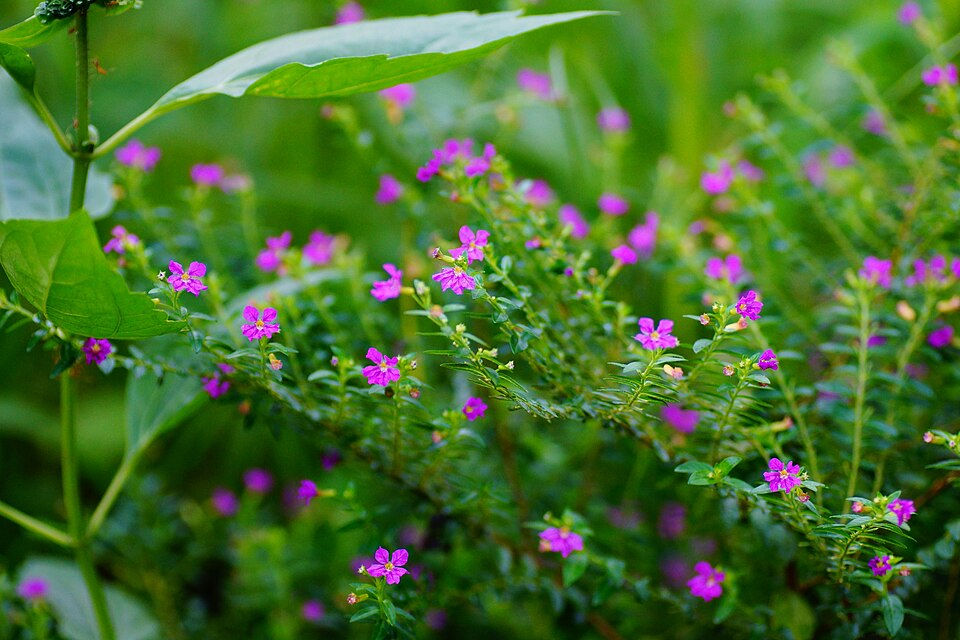
Characteristics: This is a fast-growing, low-slung, multi-branched evergreen subshrub that forms a beautifully uniform, flat-topped, lace-like green cushion. From a tough, wiry base, it pushes out a dense forest of horizontal, feather-like branches. The tiny, opposite, lance-shaped leaves are narrow, glossy, and a rich dark green, closely mimicking the texture of true alpine heather (Calluna). Throughout every warm month, the leaf axils produce an explosion of small, star-shaped, six-petaled flowers with crinkled tissue textures, held within tubular green calyces.
Pros
Non-Stop Year-Round Bloom: Pumps out a continuous, uninterrupted mist of small colorful flowers every single week of the year if kept in a frost-free environment.
Elite Geometric Border Utility: Maintains an exceptionally tidy, self-contained, low-mounded architecture that requires near-zero regular shearing to keep its shape.
High Resilience to Reflective Heat: Thrives beautifully along stone pathways, masonry borders, and southern concrete terraces without showing leaf scorch.
Outstanding Beneficial Insect Anchor: Actively draws in native solitary bees, small butterflies, and beneficial hoverflies with its easily accessible nectar tubes.
Cons
Absolute Systemic Cold Intolerance: Lacks any internal defenses against freezing temperatures; the soft woody framework suffers severe dieback at the first touch of frost.
High Leaf-Drop Under Topsoil Drought: The shallow, fine-textured root system has zero tolerance for deep soil baking, dropping its inner green leaves rapidly if left completely dry.
Prone to Scale Insects: The dense, interlocking mesh of fine inner twigs can attract localized colonies of scale insects or mealybugs if airflow stalls in humid weather.

Field Performance & Care Profile
Light Requirement: Full sun to partial shade. It achieves its tightest, most ground-hugging cushion structure and heaviest flower count when exposed to a minimum of six hours of direct, unfiltered daily solar radiation. It handles bright afternoon shade well, especially in inland zones with intense summer sun.
Cold Hardiness: Tender perennial subshrub. It handles cool autumn drops down to 5°C (41°F) safely, but experiences severe foliage browning at 2°C (35°F). Sustained freezes crossing below 0°C (32°F) will destroy the root crown, requiring it to be overwintered indoors in cold regions. (RHS Hardiness Rating H1c / WHZ 9b-11b).
Heat Tolerance: High. Comfortably endures intense ambient summer air temperatures climbing up to 38°C (100°F) without showing signs of leaf scorch, provided the soil matrix retains a baseline level of hydration.
Soil Requirement: Prefers light, lean, highly porous substrates including sandy loams, gravelly silts, and unamended mineral backgrounds. It displays an excellent affinity for a neutral to mildly acidic pH range of 6.0 to 7.2, demanding immediate drainage.
Root Structure: A dense, shallowly spreading, and highly fibrous capillary root network that concentrates heavily in the top 20 cm of soil to draw surface moisture.
Height & Spread: Grows at a moderate, highly predictable rate, reaching a uniform vertical height of 30 to 45 cm (12 to 18 inches), expanding horizontally to cover an equal footprint of 30 to 60 cm (12 to 24 inches) wide.
Watering: Moderate but highly consistent water needs. The shallow capillary roots cannot tolerate deep soil cracking or long periods of bone-dry baking. The topsoil should remain consistently damp—resembling a thoroughly wrung-out sponge. Provide a deep, gentle soaking at the base twice a week during dry summer stretches.
Regional Adaptability: Exceptionally successful as a permanent evergreen landscape asset across Southern Europe (Mediterranean coastal belts, RHS Hardiness Zone 10) and the southern/southwestern United States (USDA Hardiness Zones 9b through 11). Highly effective as a spring-to-autumn seasonal bedding plant or container asset in colder temperate zones.
Lifespan: Long-lived perennial asset when protected from frost. It maintains high structural vigor and heavy bloom volume for 8 to 12+ years, renewing its wiry wood annually from the base.
Flower Color: A vibrant spectrum dominated by rich neon-purple, lavender-pink, deep violet, and pure snow-white.
Blooming Period: Year-round in frost-free subtropical climates; running continuously from April through November in regions with mild winter transitions.
Foliage Status: Strictly evergreen. The tiny, glossy green leaves remain active, lush, and structurally constant through all twelve months of the year in frost-free microclimates.
Difficulty Level: Beginner. It is an exceptionally self-sufficient, low-input plant that demands near-zero specialized soil management, requiring only basic moisture consistency.
Propagation Methods
Late-Spring Softwood Cuttings (The Clean Clone Route): Because Cuphea hyssopifolia is highly selected for compact growth habits, multiplying specific color varieties is best achieved via vegetative means. In late spring (May), select a strong, non-flowering green terminal shoot about 8 cm long. Make a clean slice directly below a leaf joint and strip away the lower needle-like leaves. Insert the cutting directly into a highly porous, damp substrate composed of eighty percent perlite and twenty percent peat sand. Keep the tray under bright, indirect light; a robust root network will form within 10 to 14 days without the need for rooting powders.
Early-Autumn Crown Layering (The Simple Separation Route): Take advantage of the plant's low-slung, spreading architecture. In September, locate a low-growing horizontal branch that is touching bare, sandy ground. Use a small wire staple to pin the middle of the stem firmly into the loose soil, scratching the underside of the wood slightly. Cover the pinned zone with a 2 cm layer of gritty silt. By early spring, a dense mass of roots will form at the node, allowing you to slice the new plantlet away from the mother bush.
Pro Care Tips & Secrets
To prevent your false heather cushions from developing a bare, hollow center with dead woody twigs inside by their third year, you must implement the "One-Third Spring Thinning" routine. In early spring (March), just as ambient temperatures begin to warm, avoid shearing the outer canopy bluntly with hedge clippers, as this creates a dense outer shell of leaves that blocks sunlight from reaching the interior. Instead, use fine-tipped snips to reach deep into the base of the plant and cleanly remove roughly one-third of the oldest, greyest woody branches all the way down to the ground burl. This selective thinning opens up the structural core, allowing light and air to penetrate deep into the crown, which forces an explosion of fresh, bright green basal shoots that keep the cushion tight and productive.
If you are cultivating Cuphea hyssopifolia inside small terracotta pots on stone terraces and want to prevent the frustrating problem of "Flash Defoliation"—where the plant drops every single green leaf within 48 hours in July—you must eliminate erratic wet-and-dry watering cycles. This rapid leaf-drop is a defense mechanism triggered when the shallow, fibrous root network experiences a complete dry-out under high heat. The plant sacrifices its leaves to save the main stems. To secure your canopy, never wait for the pot to become bone-dry. Install a thin, 2 cm layer of clean river gravel or volcanic basalt grit over the potting soil surface to lock in topsoil moisture and keep root-zone temperatures uniform.
To ensure your false heather maintains an intense, high-saturation purple flower mist all summer without accumulating an ugly layer of grey fungal mold inside its fine foliage mesh, you must completely banish overhead sprinkler irrigation and implement exclusive "Ground-Level Hydration." The dense, feather-like arrangement of the tiny leaves easily traps water droplets from overhead watering, creating a stagnant, high-humidity microclimate within the inner canopy that acts as an open invitation for fungal pathogens. Always direct your hose nozzle or drip irrigation lines straight onto the soil surface beneath the leaf skirt, allowing the foliage to stay perfectly dry, clean, and highly aerated under the summer sun.
Tags: Evergreen-Subshrub | Moisture-Lover | Full-Sun | Low-Maintenance | Geometric-Border | Year-Round-Bloom


Comments