


The Nitrogen Networker: Black Locust (Robinia pseudoacacia)


Lightning-fast, nitrogen-fixing pioneer hardwoods engineered for eroded gravel slopes, extreme heat drops, rot-resistant timber, and cascades of honey-scented spring blossoms.
Alternative Names: Black Locust, False Acacia, Locust Tree
Introduction
Botanical Name: Robinia pseudoacacia (Family Fabaceae)
Native Habitat: Native originally to the southeastern United States (specifically the Appalachian Mountains and Ozark Plateaus). However, it has naturalized aggressively across Europe, Asia, and the Anatolian steps of Turkey. It evolved as an opportunistic pioneer species, colonizing heavily disturbed soils, forest edges, rocky mountain drops, and surface-mined lands. This rugged evolutionary history hardwires its supreme ability to synthesize its own nitrogen fuel, its reliance on direct, high-intensity sunlight, and a widespread horizontal root network designed to anchor unstable, sliding earth.
Characteristics: This is a medium-to-large, fast-growing deciduous hardwood tree reaching heights of 12 to 25 meters. In youth, it displays a narrow, irregular crown that later expands into an open, loose canopy with twisting branches. The bark is exceptionally thick, dark brown to grey, and deeply broken into deeply furrowed, intertwining fibrous ridges that resemble braided thick ropes. The compound leaves are pinnate, measuring 15 to 35 cm long, featuring 9 to 19 smooth, oval, bluish-green leaflets that naturally fold downward on dark nights. At the base of each leaf petiole, the plant develops a pair of short, sharp, woody stipular spines. In late spring, the canopy is loaded with heavy, drooping clusters (racemes) measuring 10 to 20 cm long, packed with highly fragrant, pea-like white blossoms with a distinct yellow throat blotch.
Pros
High-Output Nitrogen Generator: Symbiotic Rhizobium root bacteria continuously capture atmospheric nitrogen, rapidly transforming poor gravels into highly fertile soil zones.
Unrivaled Wood Rot Resistance: The dense, tight-grained heartwood is packed with natural anti-fungal compounds, outlasting pressure-treated timber when used as direct-soil fence posts or vine stakes.
Elite Honey and Bee Pasture Asset: The intense nectar flow produces premium, light-colored, slow-crystallizing "Acacia Honey" (akasiya balı).
Rapid Erosion Control Matrix: The wide-creeping, thick root system binds steep, sliding sand banks and degraded embankments with incredible speed.
Cons
Aggressive Root-Suckering Habitum: The horizontal root network continuously pushes up thick thickets of spiny shoots when the main trunk is pruned or damaged, invading nearby garden lines.
All-Part Toxicity Profile (Except Flowers): The bark, leaves, roots, and seed pods contain the toxic proteins robin and phasin, making them dangerous to livestock (especially horses) if chewed.
Brittle Storm Wood Density: Despite its hard weight, the fast-growing limbs can be physically brittle, snapping cleanly during high-velocity ice or windstorms.

Field Performance & Care Profile
Light Requirement: Absolute full, unrestricted sun. It is a strict pioneer species that demands maximum daily solar exposure. Seedlings will stall completely and die if grown under a dense forest canopy or adjacent structure shade.
Cold Hardiness: Outstandingly cold-hardy. The woody crown easily handles severe winter temperature drops down to minus 25°C to minus 32°C (-13°F to -25°F) without deep wood damage, surviving continental mountain drops comfortably. (RHS Hardiness Rating H7 / WHZ 4a-9b).
Heat Tolerance: Supreme. Growth continues rapidly during intense summer dry spells and heat spikes reaching up to 40°C (104°F) without foliage burn.
Soil Requirement: Unbelievably adaptable. Thrives in poor sands, gravelly scree, acidic spoils, and heavy, compacted high-lime calcareous clays. It tolerates a massive pH spectrum from 4.5 to 8.2, requiring only that the site avoids permanent, stagnant waterlogging.
Root Structure: Develops a shallow, highly branched, aggressive lateral root network that spreads far beyond the canopy line, accompanied by occasional deep-diving vertical sinker roots.
Height & Spread: Grows 12 to 25 meters (40 to 80 feet) in vertical height, developing a mature canopy spread of 8 to 12 meters.
Watering: Very low water needs once established. Requires regular watering only during its first single summer growing season. Once anchored, its expansive root grid captures natural subsoil moisture, requiring zero ongoing irrigation.
Regional Adaptability: Exceptionally successful in arid steppes, wind-swept transition fields, and degraded countryside sites. It is a premier agroforestry selection for fast windbreaks, firewood lots, and soil restoration.
Lifespan: Short-to-medium lived for a hardwood, typically reaching 60 to 90 years, though its root system can continuously generate new clone trunks indefinitely.
Flower Color: Pristine white to pale cream pea-like blossoms with a bright yellow-green spot at the base of the standard petal.
Blooming Period: Late spring (typically blooming heavily for a brief 2-week window between May and June).
Foliage Status: Deciduous. The soft, bluish-green leaves show zero autumn color change, dropping cleanly while still fresh green or a pale yellow after the first hard autumn freeze.
Difficulty Level: Beginner. A highly self-sufficient, rugged tree that requires zero chemical maintenance or specialized pruning.
Propagation Methods
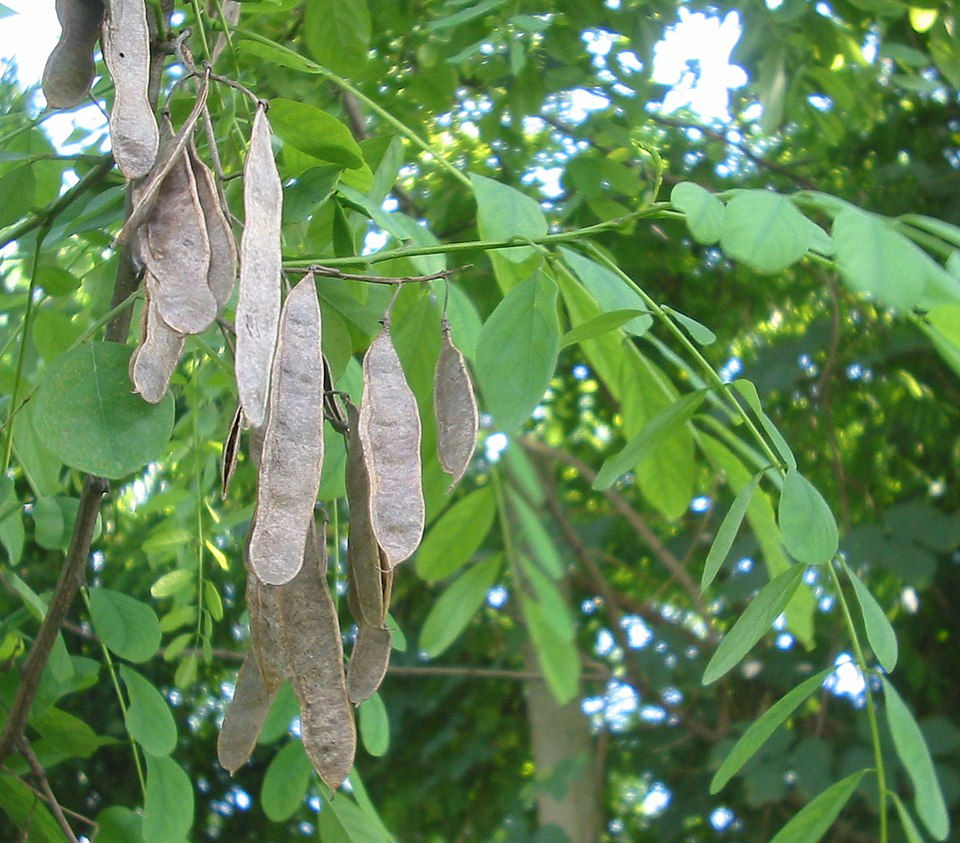
Late-Winter Boiling-Water Scarified Seeding (Mass Forestation Route): Collect dry, dark-brown seed pods from the branches in mid-winter. Extract the small, rock-hard, kidney-shaped seeds. The seed coat is completely waterproof, requiring physical disruption to sprout. Place the seeds in a heat-safe glass bowl and pour boiling water (100°C / 212°F) directly over them, letting them soak for 24 hours as the water cools. The viable seeds will swell to twice their original size. Sow the swollen seeds 1 cm deep into pots filled with standard sandy loam soil. Sprouts will burst through the surface uniformly within 5 to 7 days, growing with explosive speed.
Late-Autumn Root Cuttings (Clonal Selection Route): Dig down along the horizontal roots of an elite, straight-growing parent tree in November during winter dormancy. Cut healthy root segments measuring 1 to 2 cm in thickness into lengths of 10 to 15 cm. Mark the top end (closest to the trunk) with a straight cut and the bottom end with an angled cut. Insert the root pieces vertically into a well-drained sand-and-soil mix, ensuring the top cut sits flush with the soil surface. Keep the medium lightly damp in a cool shed; vigorous new vegetative shoots and anchor roots will erupt from the root tissue by early spring.
Early-Spring Division of Basal Root Suckers: Pull up and detach naturally occurring, young rooted suckers from the perimeter of a mature tree in March before bud break. Cleanly slice the connecting runner root with a sharp axe, preserving the fine fibrous roots on the sucker stem, and plant it directly into its new permanent site.

Pro Care Tips & Secrets
To prevent a single planted Robinia pseudoacacia from transforming into an uncontrollable "Spiny Sucker Thicket" that invades your garden walkways and chokes nearby cultivated flower beds, you must completely avoid the "Surface Tillage Root-Wounding Trap." Black Locust roots hold a massive concentration of dormant vegetative buds that remain completely asleep as long as the root bark is intact. However, if you run a rotary tiller, disk, or sharp spade through the soil beneath or near the canopy, you will slice and nick these horizontal roots. Every single cut instantly activates these sleeping buds, triggering a massive, aggressive rush of spiny root suckers that pop up out of the ground within weeks. Always use a thick, 10 cm layer of coarse wood chip mulch to suppress weeds beneath the tree instead of tilling the soil.
If you are harvesting Black Locust logs to create your own organic, chemically free garden fence posts, vine stakes, or raised bed borders, you must execute the "Late-Winter Coppice Cut" followed by "Immediate Bark Stripping." To secure wood that will last forty years in wet clay soil without rotting, saw down the timber in January when the tree's sap flow is completely dormant and its sugar content is at its lowest level. Once cut, use a drawknife or a sharp spade to peel away the thick, furrowed bark immediately while the wood is fresh. The inner bark traps moisture and attracts wood-boring beetle larvae; stripping it clean lets the dense, yellow-green heartwood cure uniformly in the open air, locking in its high concentration of natural preservative tannins.
If you want to create a beautifully contained, highly manageable, and completely thornless canopy structure for an ornamental zone, you must choose the "Top-Grafted 'Umbraculifera' Clonal Selection." If you plant the wild form, you will manage sharp thorns and a loose, irregular branch structure. Instead, purchase or graft the sterile, thornless cultivar Robinia pseudoacacia 'Umbraculifera' onto a standard wild Black Locust rootstock at a height of 2 meters. This specific selection naturally grows into a perfectly spherical, tight, dense green ball that requires zero mechanical pruning to hold its geometric shape. It never produces thorns or messy seed pods, giving you all the benefits of the tree's deep drought resilience and nitrogen fixing without the aggressive, spiny maintenance worries.
Tags: Deciduous-Tree | Nitrogen-Fixer | Drought-Resilient | Full-Sun | Rot-Resistant-Timber | Spring-Bloom


Comments