


The Orchard Crown: Peach (Prunus persica)


Vigorous, highly productive deciduous stone fruit trees engineered for high winter chill efficiency, precise pruning architectures, intense solar capture, and an abundant summer yield of aromatic, sugary drupes.
Alternative Names: Peach, Nectarine (smooth-skinned variant), Peaches
Introduction
Botanical Name: Prunus persica (Family Rosaceae)
Native Habitat: Originally native to Northwest China, specifically between the Tarim Basin and the northern slopes of the Kunlun Shan mountains, where it was domesticated over 4,000 years ago along the Yangtze River valley. It evolved in regions characterized by distinct, cold winters and warm, sunny summers. This ancestral background hardwires its physiological requirement for a mandatory winter rest period (winter chill hours) to break bud dormancy, balanced with an absolute need for high heat units during spring and summer to drive sugars into the developing fruit.
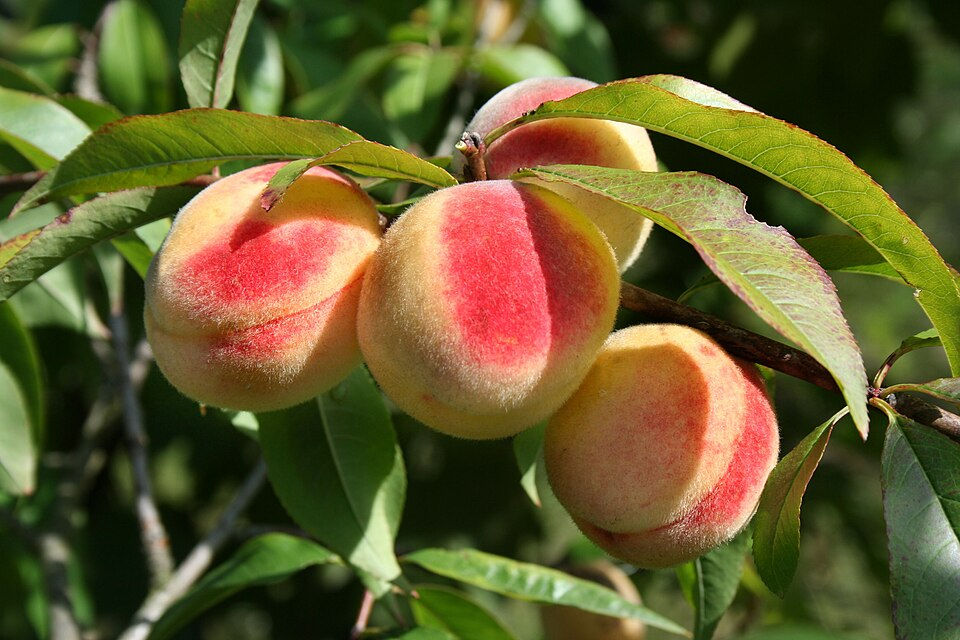
Characteristics: This is a small to medium-sized, fast-growing, deciduous fruit tree reaching heights of 3 to 6 meters with a spreading, rounded canopy. The bark is smooth and reddish-brown in youth, developing dark, fissured, rough plates with prominent horizontal lenticels as it matures. The leaves are alternate, lanceolate to oblong-lanceolate, 7 to 16 cm long, with finely serrated margins and glandular petioles that release a faint almond scent when crushed. In early spring before leaf emergence, the bare branches are covered in showy, solitary or paired, 5-lobed pink to magenta flowers. The fruit is a fleshy, velvety-skinned drupe (stone fruit) containing a hard, deeply pitted, lignified endocarp (stone or pit) that houses the seed.
Pros
High Yield Efficiency: Extremely rapid payback cycle; grafted trees begin bearing significant crops within 2 to 3 years of field establishment.
Supreme Culinary Value: Produces soft, melting-fleshed fruit with an unmatched aroma, high sugar content, and exceptional fresh-market or preserve value.
Breathtaking Spring Floral Display: Dense, pink early-spring blossom coverage turns orchards into stunning ornamental landscapes before the vegetative canopy opens.
Highly Responsive to Training: The brittle, open-branching habit responds exceptionally well to open-center (vase) pruning, maximizing light penetration.
Cons
High Vulnerability to Spring Frosts: Early blooming habit makes opening blossoms extremely susceptible to late spring freeze events that kill the flower pistils.
Severe Susceptibility to Leaf Curl: Highly vulnerable to Peach Leaf Curl (Taphrina deformans), a fungal disease that puckers, reddens, and defoliates the tree during cool, wet spring weather.
High Pruning Dependency: Requires aggressive annual winter pruning; without pruning, fruit production migrates to the outer tips, causing central branches to go bare and snap under weight.
Field Performance & Care Profile
Light Requirement: Absolute full sun. Demands a minimum of 8 hours of direct, unfiltered daily sunlight to drive flower bud differentiation and develop crimson blush skin pigmentation.
Cold Hardiness: Fully cold hardy during deep winter dormancy down to minus 18°C to minus 22°C (-0.4°F to -7.6°F), depending on the cultivar. However, opening blossoms suffer mortality below minus 2°C (28°F). Requires a specific chill window (typically 400 to 1,000 hours below 7.2°C / 45°F depending on variety). (RHS Hardiness Rating H5 / WHZ 5a-8b).
Heat Tolerance: High during fruit maturation. Thrives in dry, hot summer temperatures up to 35°C to 38°C (95°F to 100°F), provided subsoil moisture is maintained via irrigation.
Soil Requirement: Requires deep, light, highly permeable, well-draining sandy loams or gravelly loams. Thrives within a pH spectrum of 6.0 to 7.0. It has absolute zero tolerance for waterlogged, heavy clay soils, which induce rapid anaerobic root asphyxiation.
Root Structure: Typically grafted onto clonal or seedling rootstocks (Prunus persica seedlings, 'Nemaguard', 'GF 677', or 'Saint Julien A'), forming a wide-spreading, moderately deep lateral root system concentrating feeder roots in the top 40 to 60 cm.
Height & Spread: Unpruned trees reach 4.5 to 6.0 meters high and wide; managed commercial orchards maintain canopy heights at 2.5 to 3.5 meters for hand-harvest efficiency.
Watering: Moderate to high water requirements during active fruit enlargement (cell expansion stage). Drip irrigation must deliver steady, deep soil moisture from pit-hardening through harvest, avoiding wet-and-dry extremes that cause fruit splitting.
Regional Adaptability: Elite performer in Mediterranean inland valleys, sunny Aegean plains, and sheltered continental slopes with clear, reliable winters and hot, dry summers.
Lifespan: Moderate for a fruit tree; typically maintains high commercial productivity for 12 to 20 years.
Flower Color: Light pink, deep rose-pink, or magenta red with 5 delicate petals.
Blooming Period: Early spring (March to early April, preceding leaf flush).
Foliage Status: Deciduous. Leaves turn golden-yellow before dropping in mid-autumn.
Difficulty Level: Moderate to Advanced. Requires precise fungal spray timing, mandatory annual structure pruning, and active crop thinning.

Propagation Methods
T-Budding / Chip Budding on Rootstock (Commercial Standard): Because peaches grown from seed do not breed true to cultivar and possess variable root vigor, field propagation relies on budding desirable scion varieties onto proven rootstocks. Execute T-budding or chip budding in late summer (August to early September) when the rootstock bark "slips" easily. Insert a single dormant vegetative bud shield from the desired parent tree into an incision on a 1-year-old seedling rootstock 10 to 15 cm above the soil line. Wrap tightly with budding tape; the bud remains dormant through winter and shoots vigorously the following spring when the top rootstock growth is headed back.
Hardwood Cuttings (Specialized Clonal Route): Take 25 to 30 cm long hardwood cuttings from vigorous 1-year-old shoots during late autumn dormancy. Wound the basal 2 cm, treat with 2,000 PPM Indole-3-butyric acid (IBA) rooting gel, and place in a bottom-heated sand medium maintained at 20°C (68°F) through winter to induce adventitious root initials before field planting.

Pro Care Tips & Secrets
To prevent the total destruction of your spring canopy by Peach Leaf Curl (Taphrina deformans)—a fungal disease that causes leaves to distort, swell, turn bright red, and drop prematurely in May—you must master the "Dormant Copper Window Intervention." Once the leaves show symptoms in spring, systemic fungicides are entirely useless because the fungal spores infect the leaf buds during early swelling. You must apply a high-concentration copper hydroxide or Bordeaux mixture spray combined with a horticultural oil sticker in late winter at the exact stage of bud swell (just before the pink petal tips break through the brown scales). Coating the bud scales kills overwintering fungal spores before they invade expanding tissue.
If you want to avoid branch breakage and harvest large, high-sugar, market-grade fruit rather than hundreds of tiny, marble-sized, pit-heavy peaches, you must execute the "30-to-1 Leaf-to-Fruit Thinning Rule." Peaches set far more fruit than the tree's photosynthetic capacity can support. Within 3 to 4 weeks after petal fall, when the young peaches reach the size of a hazelnut, physically pull off excess fruitlets by hand. Thin the crop so that remaining peaches are spaced 15 to 20 cm apart along the fruiting branch, leaving a single fruit per lateral cluster. This ensures a ratio of roughly 30 leaves per fruit, channeling maximum carbohydrate reserves into size, flavor development, and next year's flower bud initiation.
To build a structurally stable canopy that maximizes sunlight interception and keeps all fruiting wood within easy reach from the ground, enforce the "Open-Center (Vase-Shape) Canopy Scaffold." During the first winter dormant period after planting, head the main stem back to a height of 50 to 60 cm. Select 3 or 4 well-spaced primary scaffold branches growing outward at 45-degree angles, spaced evenly around the trunk, and prune out the central leader completely. This open-center architecture allows direct midday sunlight to penetrate into the heart of the tree, preventing inner wood dieback and keeping fruiting shoots productive throughout the entire interior frame.
Tags: Deciduous-Fruit-Tree | Stone-Fruit | Full-Sun | High-Yield | Spring-Bloom | Orchard-Asset


Comments