


The Scarlet Horned Poppy: Red Horned Poppy (Glaucium corniculatum)

Resilient annual to biennial pioneer herbs engineered for intense drought endurance, glaucous silver-blue rosette architecture, long curved seed pods ("horns"), vibrant crimson-orange floral displays, and high adaptation to degraded, gravelly Anatolian soils.
Alternative Names: Red Horned Poppy, Scarlet Horned Poppy, Horned Poppy, Gelincikmsi Boynuzlu Haşhaş (Turkish), Pavot Cornu (French), Roter Hornmohn (German), Amapola Corniculada (Spanish)
Introduction
Botanical Name: Glaucium corniculatum (Family Papaveraceae)
Native Habitat: Native to the Mediterranean basin, Southern Europe, North Africa, and extending across Western Asia into Central Anatolia and the Caucasus. It naturally colonizes dry steppe lands, rocky hillsides, coastal gravel banks, fallow agricultural fields, and disturbed roadsides. Evolved in nutrient-poor, arid microclimates with intense solar radiation, it developed a thick taproot to draw deep subsoil moisture, paired with waxy blue-grey foliage that reflects harsh light and minimizes evapotranspiration.
Characteristics: A sprawling to upright annual or short-lived biennial herb growing 0.2 to 0.5 meter tall with a spread of 0.3 to 0.6 meter. Rosette leaves are deeply pinnatifid, lobed, hairy, and covered in a thick glaucous (silver-blue/grey) bloom. In late spring, stems produce solitary, showy four-petaled flowers (3 to 6 cm wide) ranging in color from deep crimson-red to fiery orange, often carrying a dark purple or black blotch at the base of each petal. The defining feature is its elongated, linear, hairless-to-hairy seed capsule (up to 15 to 25 cm long), which resembles a long curved horn projecting outward from the stem.
Pros & Cons
Pros
Extreme Drought & Heat Tolerance: Thrives in dryland ecosystems, stony steppes, and un-irrigated garden beds where most ornamental annuals wither.
Pioneer Soil Regenerator: Deep taproots penetrate compact, dry subsoils, breaking up hardpan layers while extracting deep minerals without demanding rich topsoil inputs.
Distinctive Botanical Architecture: Features striking contrast between silver-blue cut foliage, brilliant scarlet blossoms, and long structural seed horns.
High Seed Self-Perpetuation: Easily naturalizes across dry rock gardens, wild meadows, and gravelly slopes through self-seeding.
Cons
Short-Lived Life Cycle: Operates strictly as an annual or monocarpic biennial, dying back completely after setting seed.
Toxicity / Unpalatable Sap: Contains isoquinoline alkaloids (such as glaucine) throughout its tissue, making it bitter and toxic to livestock if ingested in quantity.
Taproot Transplant Sensitivity: Resists root disturbance; established seedlings rarely survive bare-root repotting or manual transplanting.
Intolerant of Wet Soil & Shade: Rapidly develops root rot and foliage melt when grown in heavy clay, stagnant moisture, or shaded conditions.
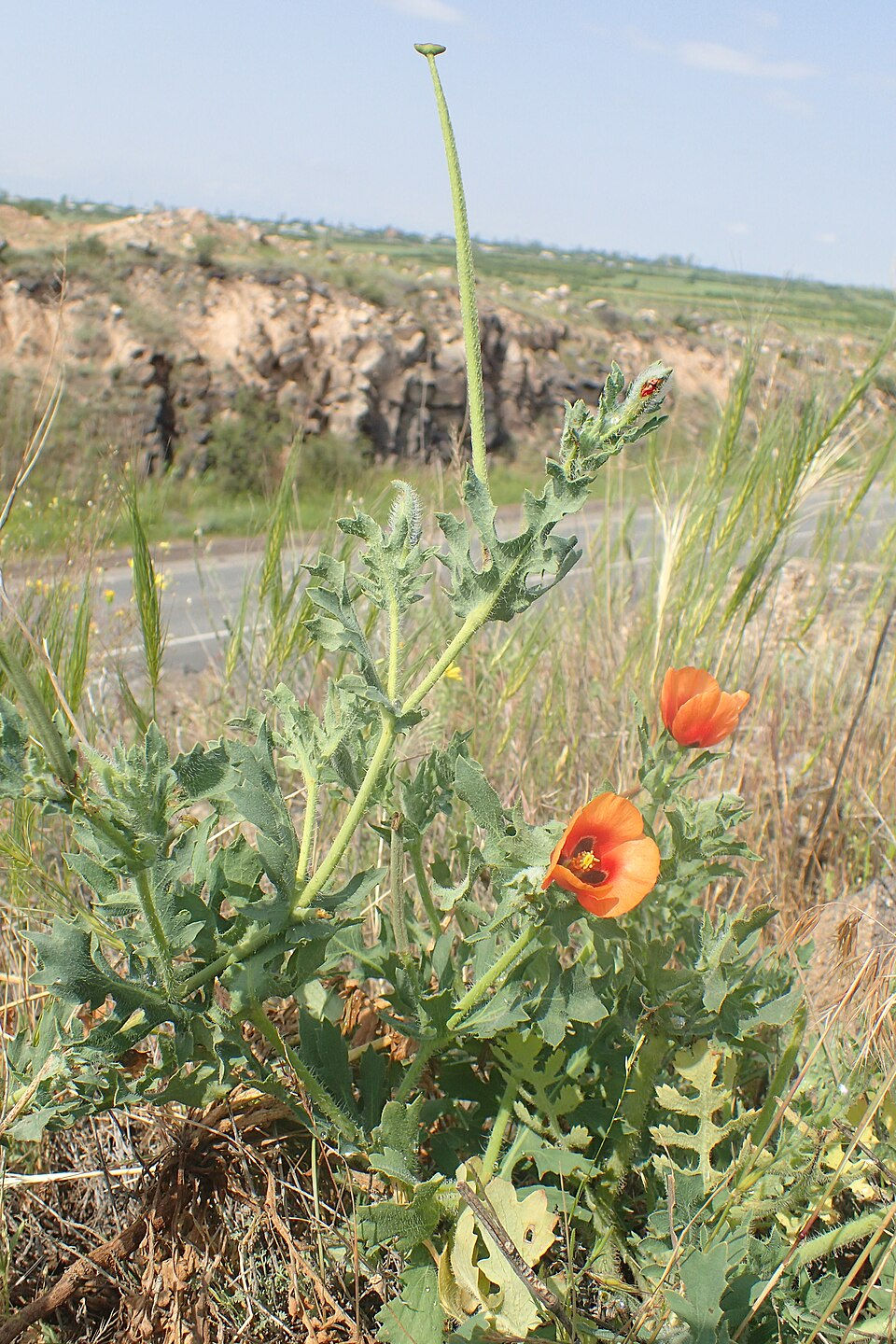
Field Performance & Care Profile
Light Requirement: Full solar radiation (6 to 8+ hours of direct sun daily). Mandatory for flower opening, vibrant petal coloration, and compact rosette form.
Cold Hardiness: Exceptionally cold-hardy annual/biennial. Overwintering basal rosettes easily withstand severe frosts down to -15°C (5°F) or lower when growing in sharply draining soils. (USDA Hardiness Zones 6a–10b).
Heat Tolerance: Extreme. Performs effortlessly through scorching summer conditions and air temperatures exceeding 40°C (104°F).
Soil Requirement: Thrives in lean, nutrient-poor, stony, gravelly, sand, or alkaline soils across a wide pH range (6.5 to 8.5). Demands exceptional drainage; rots rapidly in waterlogged clay.
Root Structure: Deep, fleshy primary taproot engineered for moisture storage and anchorage in rocky substrata.
Height & Spread: Grows 0.2 to 0.5 meter tall with a spread of 0.3 to 0.6 meter.
Watering: Very Low. Categorized in the Red/Orange Group on the Water Scorecard. Relies on natural seasonal rainfall once established. Supplemental irrigation is rarely needed and can trigger root rot.
Regional Adaptability: Essential xeriscape subject, Anatolian steppe flora accent, gravel garden plant, rocky slope stabilizer, and dry wild-meadow filler.
Lifespan: Annual to short-lived biennial (re-establishes via self-sown seeds annually).
Flower Color: Deep scarlet-red, orange-crimson, or occasionally copper-orange, often marked with dark purple spots at petal bases.
Blooming Period: Late spring to mid-summer (May to July).
Foliage Status: Basal rosette formed in autumn/early spring; foliage dries after seed maturation.
Difficulty Level: Extremely Easy (hands-off pioneer plant).
Propagation Methods
Direct Outdoor Seeding (Sole Recommended Method): Sow seeds directly into final position in autumn or early spring. Scatter seeds over well-draining, unamended gravelly soil, press lightly into the surface, and leave exposed to ambient weather. Natural stratification over winter triggers uniform spring germination.
Avoid Transplanting: Because of its sensitive taproot, growing Glaucium in traditional small nursery pots for later garden planting is discouraged. Direct sowing ensures undisturbed taproot growth.
Pro Care Tips & Secrets
To achieve "Natural Self-Sustaining Populations," enforce the "Late Seed Pod Harvest Protocol." Allow the elongated, horn-like seed pods to ripen completely on the plant until they turn dry and tan. As they split open longitudinally, let seeds scatter naturally across gravel beds or collect them by hand for direct scattering in dry target zones.
To prevent "Damping Off & Crown Rot," execute the "Lean Gravel Substrate Rule." Never amend planting areas with heavy compost, manure, or peat moss. Plant Glaucium in lean, mineral-heavy soils topped with a 3 to 5 cm mulch layer of coarse gravel or crushed limestone to keep the basal rosette leaves dry and elevated above wet topsoil.
To maintain "Clean Xeriscape Aesthetics," implement the "Post-Bloom Rosette Removal." Once the plant completes its reproductive cycle in midsummer and the seed horns shed their contents, cut dry stalks at ground level to keep dry borders tidy while allowing self-sown seedlings to emerge undisturbed around the perimeter.
Tags: Annual | Biennial | Xeriscape | Native-Flora | Drought-Tolerant | Steppe-Plant | Seed-Self-Sower | Papaveraceae


Comments