


The Spring Geophyte: Common Hyacinth (Hyacinthus orientalis)

Fragrant, spring-flowering bulbous perennials engineered for cold-induced dormancy breaking, dense racemose inflorescences, heavy volatile hydrocarbon production, and high-impact vernal color.
Alternative Names: Common Hyacinth, Dutch Hyacinth, Garden Hyacinth
Introduction
Botanical Name: Hyacinthus orientalis (Family Asparagaceae – subfamily Scilloideae)
Native Habitat: Native to the rocky limestone hillsides, open mountain slopes, and dry scrublands of Southwestern Asia (primarily Southern Turkey, Syria, and Lebanon). It evolved under a classic Mediterranean climate regime featuring cold, wet winters and hot, dry summers. The species developed a fleshy subterranean true bulb to store starches and moisture through the summer heat, relying on prolonged winter chilling (vernalization) to break embryonic bud dormancy and trigger rapid stem elongation in early spring.
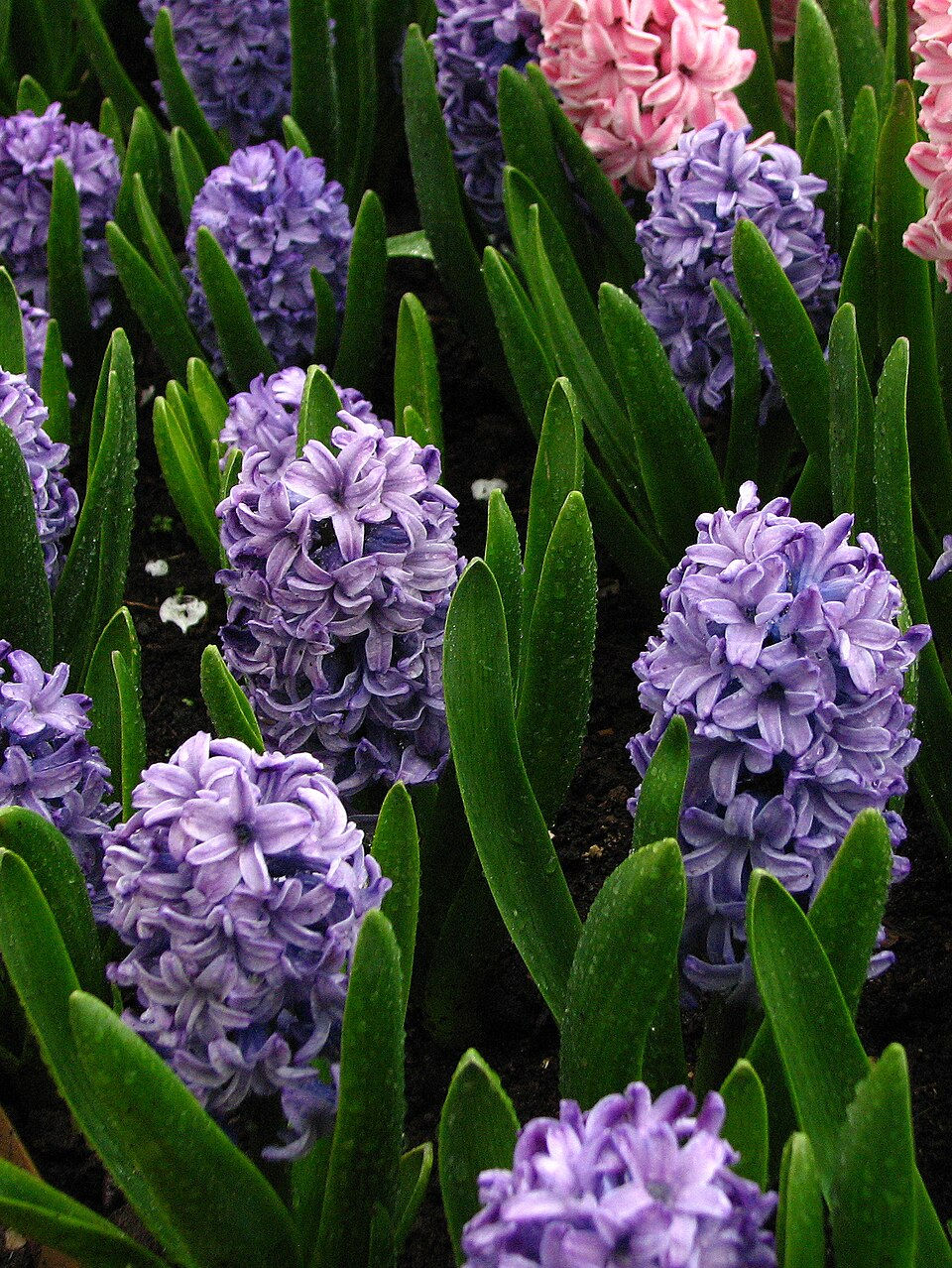
Characteristics: A compact, geophytic bulbous perennial growing 20 to 30 cm in height with an upright, rigid habit. The bulb is tunicated, broadly spherical, 5 to 8 cm in diameter, with dark purple or silvery-cream papery outer skins. In late winter to early spring, it produces a basal rosette of 4 to 6 glossy, fleshy, canaliculate (grooved) strap-like leaves measuring 15 to 35 cm long. A single, central, thick floral scape emerges bearing a dense terminal raceme of 20 to 40 highly fragrant, bell-shaped (campanulate) flowers with recurved tepal lobes. Cultivars display a wide color range, including deep violet-blue, cobalt, magenta, rose-pink, salmon, canary yellow, and porcelain white.
Pros
Intense Volatile Fragrance: Produces exceptionally powerful, sweet floral scents (rich in benzyl acetate and cinnamic alcohol) that fill enclosed rooms and garden spaces.
Symmetrical Vernal Architecture: Dense, cylindrical flower spikes provide formal structural geometry in spring bedding schemes and tabletop bowls.
High Forcing Potential: Highly adaptable to artificial cold-treatment protocols, allowing indoor bloom forcing for winter holiday displays.
Rodent-Resistant Bulbs: Contains poisonous calcium oxalate crystals and alkaloids that deter squirrels, voles, and rabbits from digging up or eating the bulbs.
Cons
Contact Dermatitis Hazard (Hyacinth Itch): The papery bulb tunics contain needle-sharp calcium oxalate crystals (raphides) that cause mechanical skin irritation and itching upon handling.
Floral Scape Toppling in Heavy Blooms: Dense flower clusters often become top-heavy, leaning or snapping in rain, wind, or loose indoor substrates.
Progressive Year-Two Decline: Forced or indoor-grown bulbs exhaust their carbohydrate reserves; without proper post-bloom foliage maturation, flower spikes in subsequent years become sparse and loose.
Field Performance & Care Profile
Light Requirement: Full solar radiation to bright indirect light during active leaf and floral development (early spring). Requires at least 4 to 6 hours of direct sunlight outdoors to rebuild bulb reserves for the following season.
Cold Hardiness: Fully cold-hardy geophyte. Bulbs require a mandatory cold-chilling period of 12 to 14 weeks at temperatures between 2°C and 9°C (35°F to 48°F) to break bud dormancy. Tolerates severe winter soil freezes down to -20°C (-4°F). (RHS Hardiness Rating H6 / WHZ 4a–8b).
Heat Tolerance: High during summer dormancy (bulbs remain dry and dormant underground). Low during active spring bloom phase; temperatures above 18°C (64°F) shorten bloom longevity significantly.
Soil Requirement: Demands exceptionally well-draining, gritty, sandy-loam soil. A mix of 50% coarse sand/pumice and 50% organic compost or topsoil with a neutral pH of 6.5 to 7.5 prevents bulb tunic rot (Xanthomonas hyacinthi).
Root Structure: Produces a seasonal ring of thick, unbranched adventitious roots extending exclusively from the basal plate at the bottom of the bulb.
Height & Spread: Grows 20 to 30 cm tall with a spread of 10 to 15 cm per bulb rosette.
Watering: Moderate during active spring growth; keep soil uniformly moist while leaves and flowers are growing. After foliage turns yellow and dies back in early summer, stop watering completely—dormant bulbs require dry soil to prevent soft rot.
Regional Adaptability: Premier spring-flowering bedder and forcing asset across temperate regions; requires pre-chilled bulb protocols when planted in frost-free warm-winter climates.
Lifespan: Perennial bulb; persists for many years outdoors, though flower density gradually decreases over time unless lifted and reset.
Flower Color: Deep blue, violet, purple, magenta, coral pink, yellow, cream, and snow white.
Blooming Period: Early to mid-spring (March to April outdoors; January to February if forced indoors).
Foliage Status: Spring-active green leaves; summer deciduous.
Difficulty Level: Easy. Highly reliable when given proper winter chilling and well-drained soil.

Propagation Methods
Basal Plate Scooping / Notching (Specialized Nursery Technique): Because hyacinth bulbs produce natural daughter offsets very slowly, commercial growers use mechanical scoring to force offset development. In late summer (dormancy), clean a mature bulb and use a disinfected curved knife to scoop out the central basal plate (or cut deep "V" shaped notches across the plate). Store the scooped bulb upside down in a warm, dark, humid place (21°C–24°C) for 2 to 3 months. Dozens of tiny bulblets will form along the exposed leaf bases, which are then planted out to grow into flowering-sized bulbs over 3 to 4 years.
Offset Division: Separate mature, naturally formed daughter bulbs from the main mother bulb plate during late summer digging and replant immediately at proper depth.
Pro Care Tips & Secrets
To avoid "Hyacinth Itch & Skin Mechanical Irritation," always enforce the "Nitrile Glove Handling Protocol." The dry, dust-like papery tunics of Hyacinthus orientalis bulbs drop microscopic, needle-shaped calcium oxalate crystals (raphides). When these crystals penetrate human skin, they trigger localized itching and mechanical dermatitis. Always wear protective gloves when handling, planting, or sorting bulbs.
To execute successful "Indoor Winter Forcing," master the "Cold-Chilling & Dark Staging Sequence." Plant bulbs in early autumn in pots containing porous potting mix, ensuring the bulb tips protrude slightly above the soil line. Place the potted bulbs in a dark location (garage, basement, or refrigerator) at 4°C to 8°C (39°F to 46°F) for 12 to 14 weeks. Keep the soil barely damp. Do not move pots into warm living areas until the pale green floral shoots reach 5 to 8 cm in height and roots emerge from drainage holes.
To prevent "Top-Heavy Stem Collapse," apply "Deep Planting & Foliage Preservation." Outdoors, plant bulbs at a depth of 12 to 15 cm (measured from the base of the bulb to soil level)—planting too shallow causes flower stems to lean and fall under their own weight. After blooming finishes, snip off the spent flower raceme to prevent seed production, but leave the foliage fully intact until it turns completely yellow and papery in early summer. This allows the leaves to photosynthesize and recharge the bulb with starches for next year's bloom.
Tags: Spring-Geophyte | Bulbous-Perennial | Fragrant-Bloomer | Cold-Hardy | Vernal-Asset | Easy-Care


Comments