


The Twilight Lantern: Four O'Clock Flower (Mirabilis jalapa)


Explosive, deep-tubered structural mounds built for baking sun, lean limestone gravel, and fragrant dusk blooms.
Alternative Names: Four O'Clock Flower, Marvel of Peru, Beauty of the Night
Introduction
Botanical Name: Mirabilis jalapa (Family Nyctaginaceae)
Native Habitat: Native to the dry tropical and subtropical highlands of Central and South America, particularly Mexico and Peru. It evolved across rocky scrub valleys, sun-baked slopes, and open mineral-heavy plateaus. This background equips the plant with an elite capacity to survive severe summer droughts by retreating into a massive, moisture-storing underground tuber while capitalizing on hot, high-pH limestone soils.
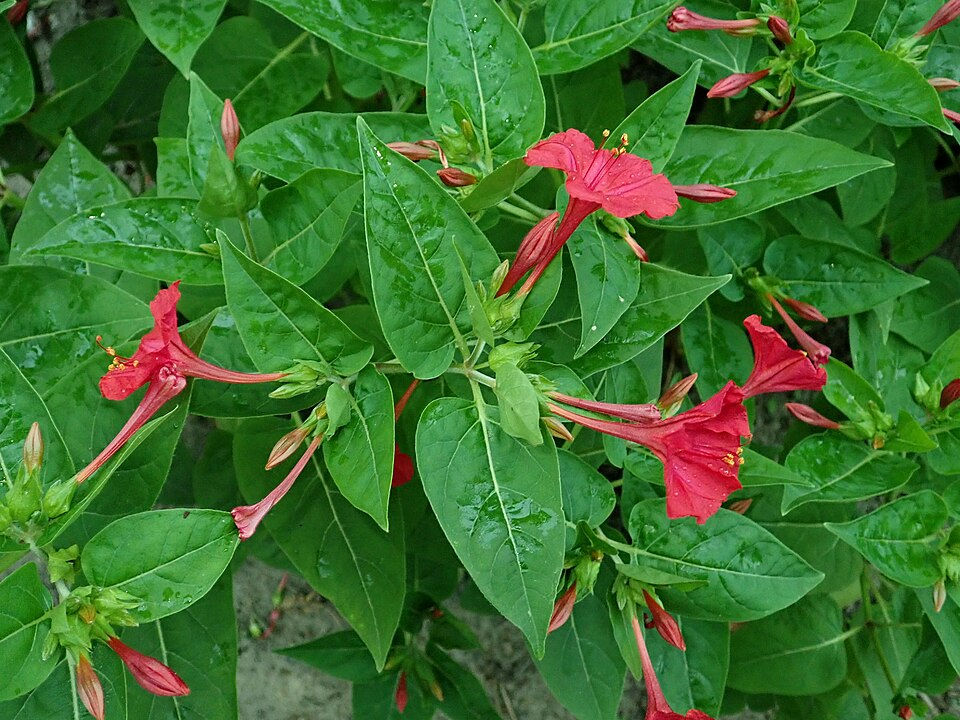
Characteristics: This is a highly vigorous, multi-branched, bushy herbaceous perennial that forms a dense, robust, hedge-like structural presence. From an expanding, heavy root tuber, it pushes out a symmetrical canopy of smooth, ovate, rich green leaves on thick, succulent stems. In a unique botanical display, the plant remains completely closed during the blazing midday heat, opening its countless trumpet-shaped blossoms precisely in the late afternoon. The flowers release an intensely sweet, citrus-and-orange-blossom fragrance that fills the evening air to attract nocturnal pollinators, before collapsing the following morning.
Pros
Elite Evening Sensory Asset: Fills the late-afternoon and night landscape with a powerful, clean perfume, making it a premier choice for seating areas and pathways.
Indestructible Storage Tuber: Houses massive water and starch reserves underground, allowing the plant to restart growth rapidly after severe droughts or winter freezes.
Outstanding Limestone Affinity: Thrives effortlessly in poor, alkaline, high-pH stony ground where delicate perennials suffer from nutrient lockout.
Aggressive Space Filler: Forms a dense, weed-suppressing green barrier within a single spring growing window.
Cons
High Seed Prolificity: Drops hard, black, grenade-like seeds aggressively, which can easily overwhelm tight, tidy rockeries if not monitored.
Total Midday Closure: The blossoms remain completely rolled up and invisible during bright, sunny daylight hours, presenting a purely green foliage mound until late afternoon.
Toxic Subsurface Parts: The heavy tubers and seeds contain mirabilisin, a chemical compound that makes them highly toxic to digging rodents and domestic pets if ingested.

The Field Performance Profile
Light Requirement
Full, unrestricted sun to light, partial afternoon shade. It requires a minimum of six hours of direct daily solar baking to produce thick, self-supporting stems and dense bud clusters. In deep shade, the structure becomes weak, floppy, and stretches horizontally.
Cold Hardiness
Down to minus 10 to minus 12 degrees Celsius (14 to 10 degrees Fahrenheit) as a perennial root. While the above-ground green canopy melts completely at the first touch of frost, the deep underground tuber overwinters safely in well-drained soil, pushing up fresh shoots every spring.
Heat Tolerance
Supreme. Shrugs off intense, ambient air temperatures climbing up to 40°C to 44°C (104°F to 111°F) effortlessly, holding its crisp foliage shape through the hottest summer weeks.
Soil Requirement
Extremely non-fussy. It thrives in poor, sandy, gravelly, or chalky mineral loams. It displays a perfect affinity for high-pH, alkaline limestone matrices with a pH range of 6.5 to 8.5, requiring only open internal drainage to protect the tuber from winter rot.
Root Structure
A massive, heavy, black-skinned perennial tuber that expands significantly with age, drilling deep into the soil profile to act as a permanent reservoir for moisture and starches.
Height & Spread
Forms a substantial, rounded, shrub-like mound. Stems typically reach 60 to 100 cm (24 to 40 inches) in height, expanding horizontally to cover a uniform footprint of 60 to 90 cm (24 to 36 inches) wide.
Watering
Low to moderate water needs. Newly planted spring seedlings require regular moisture to trigger tuber development. Once fully established, the underground root reservoir makes it highly drought-tolerant, surviving long stretches on natural rainfall alone.
Lifespan
Long-lived perennial via its tuberous root. The underground system continues to strengthen and expand for 10 to 15+ years, while the plant easily naturalizes in the surrounding landscape through dropped seeds.
Flower Color
A festive chameleonic palette of vibrant magenta-pink, bright canary yellow, pure white, and crimson. A single plant frequently showcases multi-colored blossoms, striped patterns, or entirely different colored flowers on the same branch.
Blooming Period
Mid-summer through late autumn (typically peak blooming runs continuously from July straight until the first heavy killing frosts arrive in November).
Foliage Status
Deciduous herbaceous. The lush green foliage stays structurally constant all summer, turning brown and melting completely to the ground line after the first true winter freeze.
Difficulty Level
Beginner. It is an exceptionally independent, bulletproof plant that requires zero routine specialized care once positioned in free-draining ground.
Propagation Methods
Direct Spring Seed Sowing (The High-Volume Route): Because the seeds are large, hard-shelled, and possess excellent germination rates, direct sowing in spring is incredibly reliable. Wait until frost danger has passed and the soil warms to 16°C. Prepare a patch of open gravel or sandy limestone bed. Press the hard, black, pea-sized seeds 1 cm deep into the soil matrix to protect them from birds. Keep the area lightly damp; robust, fast-growing seedlings will erupt from the ground within 7 to 14 days.
Tuber Lifting and Overwintering (The Cold-Zone Insurance): In regions with severe continental winters where temperatures drop below the tuber’s hardiness threshold, dig up the heavy roots in late autumn after frost destroys the foliage. Shake away the dirt, let the tubers dry in a shaded room for 3 days, and store them in boxes filled with dry sand or sawdust in a cool, frost-free cellar. Replant them 10 cm deep in mid-spring for a massive, early-season structural display.
Pro Care Tips & Secrets
To prevent a dedicated evening fragrance patch from turning into an aggressive weed nightmare that takes over your entire gravel garden, you must time your seed management perfectly. In late summer, look closely beneath the faded flowers; the plant builds hard, exposed, dark black seeds that look like tiny hand grenades. Do not let these drop into the surrounding gravel matrix. Instead, place a wide tarp beneath the bushes in autumn and shake the branches vigorously to collect the loose seeds, or cleanly shear the outer 10 cm of the flowering tips off in late October before the pods split open.
Never grow four o'clocks in highly fertile garden beds packed with rich organic matter or high-nitrogen commercial fertilizers. Excessive nitrogen causes a total structural failure in this species; the succulent stems stretch into long, watery, weak branches that instantly split apart at the joints or flop flat against the ground under the weight of autumn rains. Keeping the soil lean, sterile, sandy, and strictly mineral-dominant forces the plant to build a highly compact, self-supporting, globe-like frame with a significantly tougher skin and higher flower density.
If your mature four o'clock bushes begin to look slightly leggy, open, or ragged by late August after a heavy mid-summer blooming flush, perform an aggressive rejuvenation prune. Use sharp hedge shears to cleanly slice the entire green canopy back by one-third its height, cutting right into the thick woody joints. Follow this trim with a single deep soaking; the indestructible underground tuber will instantly flush out a dense carpet of pristine new leaves and a heavy, second wave of highly fragrant evening blossoms that lasts until the first true winter freeze.
Tags: Perennial | Drought-Tolerant | Full-Sun | Tuberous-Root | Aromatic-Flower | Summer-Bloom


Comments