


The Wall-Climbing Gem: Ivy-Leaved Toadflax (Cymbalaria muralis)

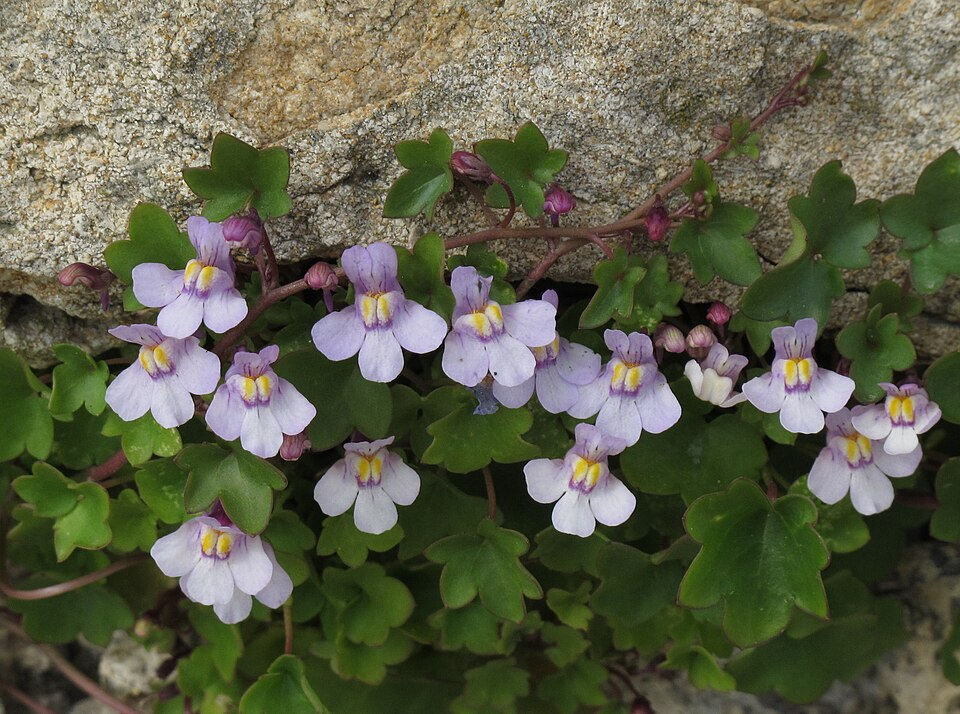
Resilient trailing perennials engineered for delicate snapdragon-like spurred inflorescences, creeping prostrate or vertical masonry habits, high micro-habitat versatility, active geotropic seed placement, and low-intervention naturalization across rock walls and shaded stonework.
Alternative Names: Ivy-Leaved Toadflax, Kenilworth Ivy, Mother of Thousands, Pennywort, Cymbalaire (French), Zymbelkraut (German), Cimbalaria (Spanish)
Introduction
Botanical Name: Cymbalaria muralis (Family Plantaginaceae / traditionally Scrophulariaceae)
Native Habitat: Native to the mountainous, rocky limestone bluffs and alpine ravines of Southern and Western Europe (principally Italy and the Mediterranean basin). It evolved in shaded, moist rock crevices, ancient mortar joints, and scree slopes. To thrive on vertical sheer surfaces, it developed a unique phototropic-to-geotropic reproductive cycle: its flowers face light to attract pollinators, but once pollinated, the flower stalks bend away from light to push developing seed capsules directly into dark masonry cracks.
Characteristics: A low-growing, delicate trailing perennial growing 0.05 to 0.1 meter tall with a cascading or creeping spread of 0.3 to 0.6 meter. Stems are thin, thread-like, reddish-purple, rooting readily at nodes where they touch damp substrate. Leaves are small (1 to 3 cm wide), palmate, ivy-like with 3 to 7 rounded lobes, smooth texture, and a slightly fleshy succulent feel. From mid-spring through late autumn, the plant produces abundant miniature, two-lipped spurred flowers (0.8 to 1.2 cm long) resembling tiny snapdragons. Petals are pale violet-blue to lilac with a bright yellow or white throat cushion.
Pros & Cons
Pros
Premier Vertical Masonry Trailer: Excels at colonizing dry-stone retaining walls, brick joints, rock gardens, and paved patio gaps where few other ornamental perennials survive.
Ingenious Self-Seeding Mechanism: Active negative phototropism ensures seeds are planted directly into adjacent wall crevices rather than falling to exposed ground.
Long-Season Blooming Window: Produces flowers continuously from early spring through late autumn frost.
High Shade & Micro-Crevice Adaptability: Thrives in low-light, cool, damp vertical microclimates with minimal soil volume.
Cons
Spontaneous Creeping Tendencies: Can spread aggressively into damp, shaded garden beds or paved paths via node-rooting stems and self-sowing if left unmanaged.
Intolerant of Heavy Foot Traffic: Soft, thread-like stems snap under direct walking or mechanical trampling.
Foliage Scorch Under Direct Sun: Midday summer sun in hot, arid microclimates causes foliage yellowing and leaf margin desiccation.
Shallow Root Limitation: Dislikes severe subsoil drought in completely un-shaded, exposed locations.

Field Performance & Care Profile
Light Requirement: Partial shade to bright indirect light (soft morning light or filtered canopy sun). Performs best in shaded northern or eastern exposures. Avoids harsh, scorching direct midday sun.
Cold Hardiness: Exceptionally hardy perennial. Evergreen foliage withstands frost down to -15°C (5°F); root crowns survive deeper freezes down to -20°C (-4°F) beneath snow or within thick masonry walls. (USDA Hardiness Zones 5a–9b).
Heat Tolerance: Moderate. Thrives in cool to warm microclimates (15°C to 28°C). Requires shaded root zones and moisture during intense midsummer heatwaves.
Soil Requirement: Unfussy regarding fertility. Thrives in lean, rocky, gravelly, calcareous soils or mortar gaps across a wide pH range (6.0 to 8.0). Prefers sharp drainage and lime-rich substrates, but tolerates moist, sandy loams.
Root Structure: Fine, fibrous, shallow root system that roots at stem nodes and anchors firmly inside narrow rock fissures.
Height & Spread: Grows 0.05 to 0.1 meter tall with a trailing/creeping spread of 0.3 to 0.6 meter.
Watering: Low to Moderate. Categorized in the Yellow Group on the Water Scorecard. Once established in rock crevices, it draws moisture from deep masonry seams. In container culture, keep the soil lightly moist, allowing the surface layer to dry between waterings.
Regional Adaptability: Essential rock garden trailer, dry-stone wall accent, shaded cobblestone filler, container cascade, and living masonry cover across Mediterranean, temperate, and alpine zones.
Lifespan: Perennial (self-perpetuating long-term colony via creeping stems and self-seeding).
Flower Color: Pale lilac-violet, sky blue, purple, and white with yellow throat spots ('Alba' cultivars exist).
Blooming Period: Mid-spring to late autumn (April to October/November).
Foliage Status: Semi-evergreen to fully evergreen in mild winter zones; dies back briefly under prolonged freezing temperatures.
Difficulty Level: Extremely Easy (virtually zero maintenance once established in suitable micro-habitats).

Propagation Methods
Division / Node Harvesting (Recommended Method): Gently lift creeping stems that have already rooted at nodes along damp soil or stone joints. Cut stems into rooted sections and press them directly into new wall gaps or potting media. Roots establish within 7 to 10 days.
Direct Crevice Seeding: Collect dry seed capsules in late summer and press seeds into damp, mortar-free joints or rock crevices where vertical growth is desired. Seeds germinate spontaneously when kept moist in spring or autumn.
Pro Care Tips & Secrets
To maintain "Controlled Masonry Bounds & Prevent Lawn Encroachment," enforce the "Boundary Shear Protocol." If Cymbalaria begins spreading beyond intended stone walls into adjacent lawn edges or delicate flower beds, simply trim creeping stems back to the masonry edge using hand shears. Stem cuttings can be composted or relocated to new stone structures.
To ensure "Rapid Vertical Establishment in Dry-Stone Walls," execute the "Mud-Plug Planting Secret." Mix damp compost, pumice dust, and soil into a thick paste. Pack this paste into vertical wall gaps, then press rooted Cymbalaria stem nodes into the plug. The moist soil plug anchors the fine roots until they penetrate deep into interior wall moisture pockets.
To protect "Foliage Density During Midsummer Heatwaves," maintain "Shaded Root Zones & Evening Misting." In warm inland climates, position Cymbalaria on the shaded side of garden walls or under deep canopy shade, providing occasional evening sprays to refresh foliage and maintain high relative humidity around rock surfaces.
Tags: Perennial | Trailing | Crevice-Plant | Rock-Wall | Shade-Tolerant | Self-Seeding | Plantaginaceae


Comments