


A Complete Guide to the Silver Dust (Senecio)(Jacobaea maritima )
- Athena
- 28 Şub
- 3 dakikada okunur

Introduction
The Silver Dust or Dusty Miller, known scientifically as Senecio cineraria (now reclassified as Jacobaea maritima), is a Mediterranean native prized not for its flowers, but for its exquisite foliage. The leaves are covered in a dense, woolly fuzz that gives the plant a frosted, silvery-white appearance—looking as if it has been dusted with moonlight.
Why You Should Grow It
It is the ultimate "contrast plant." Its silver-white leaves make the colors of neighboring flowers (like red geraniums or purple petunias) pop with incredible intensity. It is extremely drought-tolerant, salt-resistant, and its fuzzy texture makes it naturally resistant to most pests and deer.
Why I Might Skip It
While it is technically a perennial, it can look "tired" and leggy after its second year. Many gardeners treat it as an annual to keep that compact, fresh look. Also, the yellow flowers it produces in the second year are often considered less attractive than the leaves and can distract from the plant’s neat form.
Plant Care Essentials
Light Requirements
Full Sun is critical for maintaining that bright silver color. In shade, the plant will turn more green than silver, and the stems will become weak and "floppy."
Cold Hardiness
It is moderately hardy, surviving down to -10°C to -12°C (10°F to 14°F). In very cold climates, it is grown as a summer annual.
Heat Tolerance
Very high. It loves the Mediterranean sun and can handle temperatures up to 35°C (95°F) with ease, thanks to its reflective white hairs that protect it from sunburn.
Soil Preferences
It requires well-drained, sandy or loamy soil. It is very sensitive to overwatering; "lean" soil (not too rich) actually helps it maintain its silver intensity.
Root Structure
It has a fibrous, moderately spreading root system. It doesn't need much depth, which makes it perfect for containers and border edges.
Size and Spread
Typically grows to a height of 20-30 cm (8-12 inches) and spreads about 25-30 cm (10-12 inches) wide.
Watering
Low. Once the plant is established, it only needs water when the soil is dry to the touch. Avoid overhead watering (wetting the leaves) as the fuzz can trap moisture and lead to rot.
Regional Adaptability
In Europe, it is native to the Mediterranean coast (Spain, Italy, Turkey). In North America, it is popular in all states as a bedding plant, especially in coastal or arid regions.
Lifespan
It is a short-lived perennial (often 2-3 years) but is most frequently treated as a half-hardy annual in professional landscaping.
Flower Color
Produces clusters of bright yellow, daisy-like flowers.
Blooming Period
Primarily in Mid-Summer. (Note: Many gardeners cut the buds off to keep the focus on the foliage).
Foliage Status
Evergreen in mild climates. The stunning silver-white leaves persist through the winter unless the temperature drops below its hardiness limit.
Difficulty Level
Beginner. If you can avoid overwatering it, it will look perfect with zero effort.
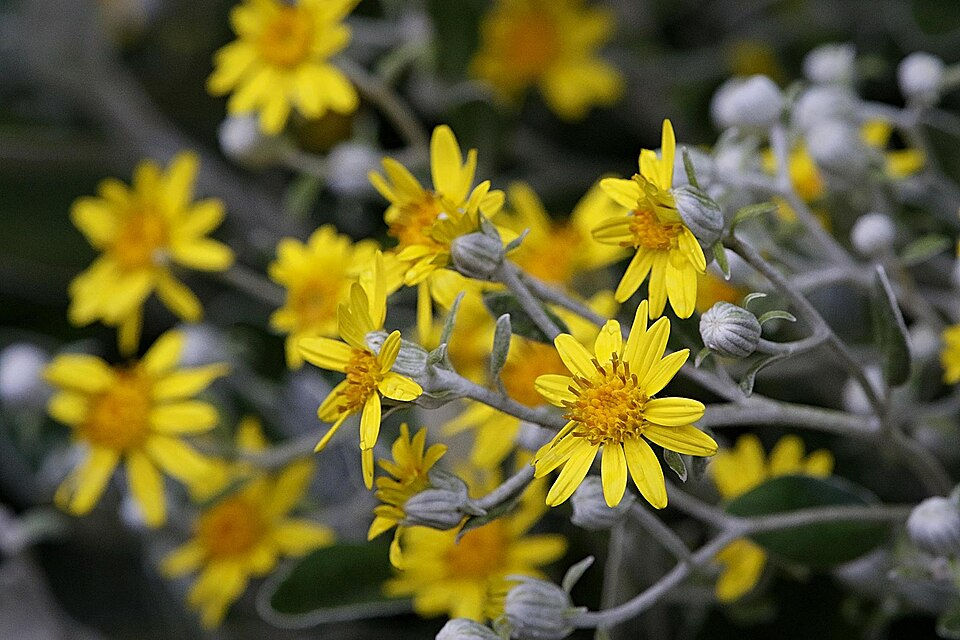
Photo by: Stephen James McWilliam Propagation Methods
1. Softwood Cuttings (Recommended)
Take 8-10 cm cuttings in late summer. Remove the lower leaves and stick them into a mix of sand and peat. They root quite easily if kept in a bright, warm spot.
2. Seeds
Sow seeds indoors 8-10 weeks before the last frost. Do not cover the seeds with soil, as they need light to germinate. Maintain a temperature of around 20°C (68°F).
Pro Care Tips for Success
The "Clip the Blooms" Rule: Most professional gardeners cut off the yellow flower stalks as soon as they appear. This forces the plant to put all its energy back into the silver leaves and keeps the mound dense and compact.
Avoid Mulch: Like many silver-leaved plants, Senecio hates humidity around its base. Use gravel instead of wood mulch to prevent the bottom leaves from rotting.
Editor’s Note
Senecio is the "tuxedo" of the garden—it makes everything else look more sophisticated. I love planting it alongside dark purple Salvia or deep red Roses; the contrast is so sharp it almost looks like a professional photograph. It’s also one of the few plants that actually looks better when the sun is at its harshest!